
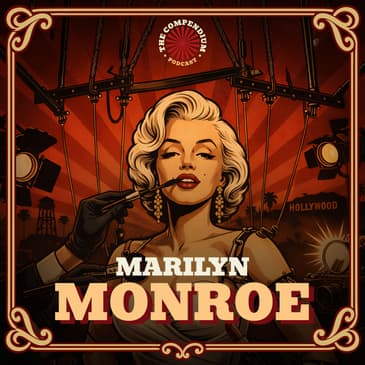
Marilyn Monroe is one of the most recognisable women who has ever lived, but the version the world fell in love with was built out of trauma, reinvention, and a Hollywood machine that knew exactly how to turn Norma Jean into a fantasy. This episode follows the making of Marilyn Monroe from unstable beginnings to global icon, tracing the fame, image-making, marriages, and myths that made her unforgettable while steadily eclipsing the woman underneath.
The white dress, the breathy voice, the “Happy Birthday, Mr President” performance — that is the version of Marilyn Monroe most people think they know. What lies underneath is a far more complicated story: a shy, anxious girl shaped by instability, foster homes, abuse, and loneliness, who was gradually transformed into one of the most famous women in the world.
From there, the story moves through the machinery of her rise: the chance photographs that opened the door, the modelling, the studio-crafted voice, the blonde bombshell image, the films, the marriages, and the relentless pressure of public fantasy. What emerges is not just the making of an icon, but the story of a woman forced to live inside an image that grew bigger, louder, and more powerful than her real life.
What Happened to Marilyn Monroe?
Marilyn Monroe was born Norma Jean into a life marked by instability from the very beginning. Long before she became a Hollywood icon, she was a child passed between homes, exposed to abuse, and pushed into an early marriage largely as a means of survival. The insecurity and loneliness of those early years never really left; they simply followed her into adulthood, even as fame changed everything around her.
Her life took a dramatic turn when she was photographed while working in a munitions factory during the war. That moment opened the door to modelling, and from there Norma Jean was steadily refashioned into Marilyn Monroe. The name changed. The hair changed. The voice changed. The image changed. And, in time, she was expected to change with it, becoming the exact version of herself Hollywood knew how to package and sell.
As Marilyn Monroe’s fame grew, so did the limits placed around her. She became a sensation, but also a product: boxed into the blonde bombshell image, typecast, managed, and endlessly scrutinised. Behind the glamour sat a much messier reality shaped by power struggles, marriages, addiction, public fascination, and the exhausting demands of celebrity. By the end, Marilyn Monroe’s life had become a collision between a private person and a public myth so enormous it threatened to swallow her whole.
Why This Story Matters
Marilyn Monroe’s story still matters because it is not really about glamour, at least not for long. It is about what happens when a person becomes more valuable to the world as an image than as a human being. That is what gives her life its lasting power: not just the fame, but the cost of it.
What makes this story especially compelling is that Marilyn Monroe was never simply a passive victim of celebrity. She was ambitious, funny, media-savvy, and often far more intelligent than the people trying to control her. She understood publicity, performance, and the power of image. But she was also carrying deep damage from childhood while trying to survive inside a system that wanted her luminous, desirable, compliant, and endlessly marketable all at once.
That tension is what makes her story endure. Marilyn Monroe the icon is easy to recognise. Marilyn Monroe the fantasy is easy to sell. But Norma Jean is the part that still hurts, because she is the reminder that behind one of the most enduring images in modern culture was a woman trying to live inside a version of herself the world felt entitled to own.
Topics Include
norma jean’s childhood, foster homes, and abuse
how marilyn monroe was made by hollywood
the breathy voice, the bombshell image, and studio control
joe dimaggio, arthur miller, and public fascination
jfk, conspiracy theories, and the final unraveling
Resources and Further Reading
Marilyn Monroe - Encyclopaedia Britannica
Marilyn Monroe - FBI Vault
Marilyn’s Method - The Criterion Collection
[00:00:01] Kyle Risi: Adam. What do you know about Marilyn Monroe?
[00:00:04] Adam Cox: What don't I know? well, obviously she's like this huge, actress pinup, sex symbol. One of those greats that kind of died too young,
[00:00:16] Kyle Risi: exactly. She's the most famous woman in the world. But Adam, there was a very clear difference between the Marilyn Monroe we saw on screen and the woman, she actually was.
This was a woman who was deeply troubled a product of an upbringing Marked by profound instability. Passed from home to home and thrust into a world she was just not equipped for.
[00:00:37] Adam Cox: And so Who was she then?
[00:00:39] Kyle Risi: Marilyn Monroe is completely manufactured from the way she moves, the way she talks. Adam, she had a stammer.
[00:00:46] Adam Cox: oh really? Wow. I did not know that.
[00:00:48] Kyle Risi: The voice we know is actually results of years of therapy and practise. A trauma that honestly never fully went away.
But She's a pioneer She brought about real change But Adam, when every day is a fight, it's only a matter of time before even the mighty begin to lose steam.
[00:01:31] Kyle Risi: Welcome to the Compendium. An Assembly of Fascinating Things. A week Leave variety podcasts that gives you just enough information to stand your ground at any social gathering.
[00:01:40] Adam Cox: We explore stories from the darker corners of true crime, the hidden gems of history, and the jaw dropping deeds of extraordinary people.
[00:01:47] Kyle Risi: I'm Kyle Reese, your Ring Master for this week's episode.
[00:01:50] Adam Cox: And I'm Adam Cox, the annual Leave Lion replacement Officer.
[00:01:54] Kyle Risi: You go on.
[00:01:55] Adam Cox: Well, as you know that all lions have to take an annual trip back to Africa.
[00:02:01] Kyle Risi: Oh. Like haj.
[00:02:02] Adam Cox: Sure. I dunno what that is, but Yeah,
[00:02:06] Kyle Risi: It's like an Islamic pilgrimage back to um, the epicentre of where like Islam started.
[00:02:12] Adam Cox: That's exactly right. They're going back to lions rock.
[00:02:14] Kyle Risi: Okay.
[00:02:17] Adam Cox: And so that means the circus is left without any lions. So I have to round up as many domestic cats as I can.
[00:02:27] Kyle Risi: God
[00:02:27] Adam Cox: dress them as lions.
[00:02:29] Kyle Risi: Yeah. 'cause you can get those mains now, can't you?
[00:02:30] Adam Cox: Yeah. I put, I'd get 'em off Temu.
[00:02:32] Kyle Risi: Yeah. Two for one
[00:02:34] Adam Cox: And dress up the cats. To be honest, the audience, they don't really notice
[00:02:38] Kyle Risi: really.
[00:02:38] Adam Cox: yeah, they're dumb.
[00:02:40] Kyle Risi: You've got a cat going, wow, wow.
[00:02:42] Adam Cox: I just have to feed it some dreamies to get up onto a ramp.
[00:02:45] Kyle Risi: they're gonna know because think about James's meow. It is awful. He sounds got
[00:02:50] Adam Cox: sound effects, Kyle.
[00:02:51] Kyle Risi: Okay, sure.
[00:02:52] Adam Cox: So when they yawn, I just press a button or a big roar comes out.
[00:02:55] Kyle Risi: So, As well as having you on the payroll, we also have to extend the responsibilities of the sound effect guy.
[00:03:01] Adam Cox: Yeah.
[00:03:02] Kyle Risi: To make this plausible.
[00:03:03] Adam Cox: Yeah. It's only for a couple of months, a year. It's fine.
[00:03:05] Kyle Risi: It's a long time that they're away for guys, if you are new to the show and you wanna support us, then the apps do best way to do that. Enjoy exclusive pers. It's to join us over at Patreon because signing up is free and you will get access to next week's episode a whole seven days before anyone else.
[00:03:21] Adam Cox: And for as little as $5 a month, you can become a fellow freak of the show, which will unlock our entire back catalogue. Yes. Which you can delve into.
[00:03:29] Kyle Risi: Mm-hmm. Dabble, explore,
[00:03:31] Adam Cox: experiment.
[00:03:32] Kyle Risi: Experiment. This is not for me, Ben, Adam, of course. The real reason why people sign up as a certified freak or a big top tier member is that they get exclusive access to something that you cannot get anywhere else. Unless you go to our website buy one.
[00:03:49] Adam Cox: That's right. You don't get it in the Freeman's catalogue.
[00:03:51] Kyle Risi: Yeah. But you get access to our one of a kind compendium key chain.
[00:03:55] Adam Cox: Mm-hmm.
[00:03:56] Kyle Risi: It has become known classically all over the world, like across. Two continents.
[00:04:02] Adam Cox: Maybe three.
[00:04:03] Kyle Risi: Maybe three.
[00:04:05] Adam Cox: Ancient civilizations have been talking about it for years, centuries. In fact,
[00:04:09] Kyle Risi: they have, and it's called the crotch dangler. And the purpose is that, we can always be there dangling delicately by your crotch.
[00:04:19] Adam Cox: Yeah. Next time you're sitting on the loo looking down,
and lastly, please follow us on your favourite podcast app and leave us a review because your support helps others find us and keeps these stories in your feed so you don't have to look for us.
[00:04:32] Kyle Risi: Yes, please. And it really helps us because like on a Tuesday, 'cause that's our release day. When it arrives, it immediately goes into your downloads.
[00:04:40] Adam Cox: Yeah.
[00:04:40] Kyle Risi: that helps the algorithm go, wow, so many people are listening to this episode. Let's feature it. So the more people that follow us, the more we get featured and then the more people that follow the show, just do it.
Adam, that is enough of the housekeeping because today on the compendium we are diving into an assembly of beauty turned industry longing turned persona. Fame that always came with a bill.
[00:05:09] Adam Cox: Hmm. Interesting fame with a price. What fame is not without price.
So you could be talking about anyone.
[00:05:16] Kyle Risi: No, I'm talking about this one very specific. 'cause it's It's a big anniversary.
[00:05:20] Adam Cox: Okay.
[00:05:20] Kyle Risi: Adam, in 1917, 15-year-old Gladys walked down the aisle to marry her Prince Charming 28-year-old John Baker.
After the wedding, the couple, they didn't waste any time getting to work. You know, no television, no Netflix, none, none of that.
So it wasn't long before Gladys had given birth to their second child, Bernice. A little sister to Robert, you could even say.
[00:05:45] Adam Cox: Mm-hmm.
[00:05:46] Kyle Risi: Gladys now having a family of her own, realised that this was the happiest that she'd ever been in her entire life.
But Adam, very soon, the fairytales started to unwind when John's Prince charming facade started to slip away, and Gladys found herself trapped in a cycle of abuse.
So knowing she needed to protect Bernice and Robert, Gladys decided to file for divorce a big thing for like 1920s, right?
Mm-hmm. It is not something you do on a whim.
[00:06:14] Adam Cox: Yeah, yeah.
[00:06:14] Kyle Risi: What she didn't realise was that this didn't automatically afford her custody of her children, and eventually custody was awarded to John, who promptly packed up her kids and moved them back to his home state of Kentucky.
This is a massive loss for Gladys, like it leaves a massive, gaping hole in the purpose that she had found in her life. And as a result, Gladys ends up slipping into a two year depression.
But Adam, in 1924, still reading from the heartache of losing her two children, Gladys saw light on the horizon when she met a man named Martin Edward Morson.
When Martin proposed, Gladys recognised this as a potential second chance to having another family, it's sad because yes, I get it, but really this is just putting like a bandaid over the previous loss because she still lost their kids.
[00:07:07] Adam Cox: Yeah. Like I'm guessing she has no access to them or anything like that.
[00:07:11] Kyle Risi: No, nothing like, I don't think she has the means to physically go and visit them in Kentucky.
But Adam, again, a few months into the marriage, Edward also turned abusive. And so not wrong after leaving him, Gladys had fallen right back into that depression.
This also ended up taking a real psychological toll on her too. Her life just felt aimless. She skipped from job to job. She couldn't find happiness or joy in just the day to day.
Then one morning, soon after a meaningless encounter with her supervisor at her job, working at the RKO Studio as a negative film cutter, Gladys woke up to a familiar feeling in her belly.
[00:07:50] Adam Cox: She's pregnant.
[00:07:51] Kyle Risi: She was pregnant.
The father, of course, didn't want anything to do with the baby, and her friends warned her that without the support of her husband, life was going to be difficult.
But for Gladys, you know, at this moment in time, it just didn't matter. For the first time in years, she felt a sense of true happiness.
And so on the 1st of June, 19 26, 100 years ago, to the day Gladys gave birth to a healthy baby girl that she named. Norma Jean.
[00:08:18] Adam Cox: Ah, okay.
[00:08:20] Kyle Risi: Today on the compendium, Madam, I'm gonna tell you about the incredible story of Marilyn Monroe.
[00:08:27] Adam Cox: Wow.
[00:08:28] Kyle Risi: What do you know about Marilyn Monroe?
[00:08:30] Adam Cox: Well, what don't I know?
[00:08:33] Kyle Risi: Yeah.
[00:08:36] Adam Cox: Quite a lot actually.
[00:08:38] Kyle Risi: Go on. Oh, okay.
[00:08:39] Adam Cox: Obviously she's like this huge, or was this huge actress pinup, sex symbol. One of those greats that kind of died too young,
[00:08:49] Kyle Risi: yes.
[00:08:49] Adam Cox: Um, But yeah, she was one of the biggest movie stars and models. Ever really. She's got this whole legacy. So she was in a lot of movies known she played that dumb blonde in a lot of her music.
[00:09:01] Kyle Risi: Yeah. She was very much typecast, wasn't she?
[00:09:03] Adam Cox: Yeah. I think early on in her career. But was a couple breakout roles she had towards the end, but then she sadly died.
[00:09:08] Kyle Risi: Mm-hmm.
[00:09:09] Adam Cox: But yeah, she's a legend. Really.
[00:09:11] Kyle Risi: That is the thing. She's a massive legend. And this is also a massive anniversary. This is going to be 100 years to the day that she was born.
And so I thought, let's actually celebrate this brilliant icon. And actually, like, I had so many preconceived ideas of who she was as an actress, and I honestly didn't think she was very good In my mind. I just thought, yes, she was a blonde bombshell. She was typecast as this and she was gorgeous.
[00:09:34] Adam Cox: Mm-hmm.
[00:09:34] Kyle Risi: But I was like, as an actress, was she any good? And in my mind I didn't really get the sense that she was very good.
[00:09:40] Adam Cox: I think. 'cause a lot of her roles were that kind of ditzy blonde,
[00:09:44] Kyle Risi: yeah.
[00:09:44] Adam Cox: character. I think she probably developed those acting chops as time went on, but I think early on she probably, yeah.
Did
[00:09:51] Kyle Risi: you call them acting chops?
[00:09:53] Adam Cox: Yeah,
[00:09:53] Kyle Risi: my acting chops.
[00:09:54] Adam Cox: That's what they call them. Your acting chops.
[00:09:56] Kyle Risi: What is that?
[00:09:57] Adam Cox: Well, they're different to your cleaning chops. Your DIY chops, your acting chops. It's a term.
[00:10:02] Kyle Risi: Yeah, but what's a chop?
[00:10:03] Adam Cox: I don't know.
[00:10:06] Kyle Risi: Okay. Chops. Her acting chops, but yes, exactly. And I think it's because that association with being the blonde bombshell, if you will, that just, people assume that she wasn't very good, but she did have a reputation of not being great.
[00:10:18] Adam Cox: Yes. And also she wasn't even blonde.
[00:10:21] Kyle Risi: Oh, so you do know quite a lot about her.
[00:10:22] Adam Cox: I know a little bit about her.
[00:10:24] Kyle Risi: Wrap the story up.
[00:10:25] Adam Cox: Okay. And we're done.
[00:10:26] Kyle Risi: No, there is a lot of stuff about her life that is just so fascinating to me and a lot of surprising things. But also, she's a pioneer of the film industry. When we think about like the old classic Hollywood, studio system and how it operated back then, they were very much in control of the actors and the stars. But actually as time went on, a lot of them started to negotiate, better contracts, better pay, more freedom away from the studio to be able to work on other projects.
And she actually was one of the people that actually pioneered that movement.
[00:10:57] Adam Cox: Oh, really? Yeah. Because at the time, or at least like what, the forties and fifties, if you're an actor, you are tied to a studio to do X amount of films. You are either with, Warner Brothers or Fox or whatever it was. But it's just completely different now.
Now you like jump ship all the time, right?
[00:11:12] Kyle Risi: exactly. And it was her that actually helped really pioneer that, but they treated her like dirt.
[00:11:18] Adam Cox: Really.
[00:11:18] Kyle Risi: And it's such an incredible story and I'm really excited to dive into it.
[00:11:23] Adam Cox: Okay.
[00:11:23] Kyle Risi: But before we do, I wanna fill in a little bit more gaps about Norma Jean's early life, because actually Adam, it really gives us an indication of who she was, the pain that she carried with her but also how ill-equipped she was for the movie business.
she has just been born and it is fair to say, Adam, that at this point in history, Gladys's friends are completely right. Having Norma at a wedlock is going to be difficult, especially given Gladys's financial situation and her already fragile mental health, it is almost impossible for her to work and care for a baby at the same time. And the strain only makes that mental health even worse.
And so as a result, Norma Gene ends up being placed into the foster care system with a couple named Albert and Ida in a small rural town of Hawthorne. It's about 30 minutes away from la.
But really interestingly though, Albert and Ida, they are also fostering Gladys,
[00:12:16] Adam Cox: what The mother?
[00:12:17] Kyle Risi: Yeah. She moves in with them and the aim here is for them to support her while Gladys is trying to raise Norma.
Okay. So I think it's actually quite an interesting setup. I dunno why we don't have something like that today where you also foster the mother and you support her raising the kid.
[00:12:30] Adam Cox: That makes a lot of sense.
[00:12:32] Kyle Risi: It does.
[00:12:32] Adam Cox: I guess you need the room to obviously. Do that with two people.
[00:12:35] Kyle Risi: Yes.
[00:12:36] Adam Cox: But it feels if you've got like an outhouse that's perfect way to do it.
[00:12:39] Kyle Risi: Perfect. Yes. And so for work, Gladys would commute to LA every day.
It's about 30 minutes, but for whatever reason, the journey is very, very difficult. It might be down to like the public transport that's available or the infrastructure, I'm not sure. And so in 1927.
Because of the difficulty of commuting, Gladys actually decides that she's gonna move to la and so she leaves Norma in the full-time care of Albert and Ida, and of course she'll come back to Hawthorne on the weekends and visit on holidays.
And by all accounts, she does try her best to be a very good mom. After all. This is something that she has wanted for so long, right? Mm-hmm.
Because whenever she's in Hawthorne, she always plans activities days out with Norma. She's really dotting mother, but circumstance. Her mental health means that she can't be the mother that she really wants to be.
[00:13:27] Adam Cox: Yeah,
[00:13:27] Kyle Risi: But Adam, for a time, this does pay off because by 1933, she has finally saved enough money to support Norma independently.
She buys a small house in Hollywood, and for about a year, things really do look blissful. But then Gladys's mental Health takes another turn, and she's eventually diagnosed with paranoid schizophrenia, and as a result, she's eventually committed to a psychiatric hospital.
[00:13:49] Adam Cox: That means Norma's taken away or again, put back into foster care.
[00:13:52] Kyle Risi: Yeah, that's it. The thing is though, Albert and Ida, they can't look after. Norma Jean on their own. Mm-hmm. they could support Gladys in raising her, but they can't do it for her.
And so Gladys's friend, Grace McKee Godard, she offers to take Norma in and care for her. The original arrangement was that it would just be temporary. But when it's clear that Gladys will need long-term hospitalisation, grace has no choice but to place Norma into the foster care system and Adam, the next few years are gonna be rough.
She's moved around constantly. She's constantly changing schools. There's no stability or a constant caregiver. And so for all intents and purposes, she feels extremely alone in her life.
And what is really sad is that because of the grief of losing Bernice and Robert, Gladys does not actually tell Norma. That she has siblings.
[00:14:41] Adam Cox: Oh, really?
[00:14:41] Kyle Risi: It's not until she's 12 years old that she finally finds out, but by then she finds out that Robert has actually already died.
[00:14:48] Adam Cox: Oh, that's sad.
[00:14:49] Kyle Risi: And as for Bernice, while she knows she exists, they don't actually meet up until they're both like adults.
And so it's really sad that she grows up feeling the sense of loneliness, where perhaps if she knew about her siblings, maybe things would be different.
I'm not saying that maybe she could have gone to Kentucky that might not been an option, but she wouldn't have felt alone in this world. Yeah. Do you know what I mean?
[00:15:10] Adam Cox: Yeah. She would've felt like she had other family, right?
[00:15:12] Kyle Risi: Yeah, exactly. And so after Grace places her in the foster care system, norma is matched with the Atkinson family, Adam. It's horrible because the father starts sexually abusing her.
[00:15:23] Adam Cox: Oh, really?
[00:15:24] Kyle Risi: And as a result, she becomes extremely withdrawn and shy. Like you had this kid who was like, do you know what? I don't have the best start in life, but I'm confident. I've got this wonder.
But that sexual abuse is one thing that transforms her into this really shy, withdrawn topic kid.
[00:15:42] Adam Cox: And that's crazy. 'cause I guess, did they not have the same sort of welfare or checks at that point?
[00:15:48] Kyle Risi: The system does find out, and Norma is taking away again and again. That just adds to the instability of her formative years.
But the thing is, because of this abuse as well as the withdrawal and the shyness, she actually loses. All of her childhood confidence. So much so that she develops a stammer.
[00:16:07] Adam Cox: Oh, really?
[00:16:07] Kyle Risi: Yeah. Which is really interesting because Marilyn Monroe is known for her voice, right?
Mm-hmm.
It's almost as iconic as her image herself, right?
[00:16:16] Adam Cox: Yeah. Yeah.
[00:16:16] Kyle Risi: Like, just think of that really famous rendition of Happy Birthday that she sings to jFK and in film, she speaks in that breathy tone. Do you know what I mean? Really seductive. It's alluring.
[00:16:26] Adam Cox: Yeah.
[00:16:26] Kyle Risi: So it's really strange to imagine her with the stammer, but it is a really bad stammer.
[00:16:32] Adam Cox: I'm guessing that's something she overcame
[00:16:34] Kyle Risi: later. Yes.
The voice that we actually know of her today is actually results of years of therapy and practise.
[00:16:40] Adam Cox: Really? Wow.
[00:16:41] Kyle Risi: Yeah. Just as her career has taken off, the studio that takes, Ron sends her to speech therapy where they teach her the onset method, where she's taught to speak with this breathy phrasing, starting sentences with like soft H sounds
this is meant to relax vocal chords and prevent like stammer blocks. And it really works. This is how she ends up with that iconic voice that becomes her signature.
[00:17:02] Adam Cox: No way. So you've got all these actresses with STAs that're all speaking like this in Hollywood.
[00:17:07] Kyle Risi: Who else has got a stammer?
[00:17:08] Adam Cox: I don't know. But anyone that's speaking with a breathy voice, I think we can now safely say
[00:17:13] Kyle Risi: Oh, I see. Yeah. So yeah, and this was at the time as a proven technique to help with that as well.
Eventually, Adam, of course, as I said, it comes out that the Atkinson dad was abusing her, and so the state removes her and they actually send her to an orphanage.
It is here that one of the staff members thinks that she'll be better off living with a family. Isn't every child better off living with a family? Why her? Why do they go, yeah, let's put her with a family.
What about the others? The
[00:17:39] Adam Cox: rest of them can fend for themselves.
[00:17:41] Kyle Risi: Yeah. Do you remember Stuart Little when they go to the orphanage and they're looking for a kid to adopt and none of the kids are good enough, but a mouse is.
[00:17:52] Adam Cox: Yeah. I never thought of it like that.
[00:17:54] Kyle Risi: So bad.
[00:17:55] Adam Cox: No, isn't it? Because he is all like alone and
[00:17:57] Kyle Risi: but what about the other kids?
[00:17:59] Adam Cox: Yeah, but he's furry.
[00:18:03] Kyle Risi: So what you're saying,
[00:18:04] Adam Cox: I like a hairy child,
[00:18:06] Kyle Risi: Marilyn Monroe is furry. Anyway, the staffer reaches back out to Grace and they negotiate that her and her husband Doc become Norma's legal guardians.
But Adam, sadly, after this doc starts sexually abusing her,
[00:18:22] Adam Cox: oh my G again.
[00:18:23] Kyle Risi: Yeah, it's awful.
Luckily, grace ends up losing her job, which means that they can't afford to support Norma at all. And so they send it to live with Grace's elderly aunt, a woman called Anna Atkinson Lowera.
To be honest, it is here that for a few years she really does find stability. She'd no longer be molested. She has a solid routine. Anna is really kind to her. She ends up enrolling in school where she stays long enough to actually make friends and build connections.
But Adam at school, she's not great and don't hold that against her. 'Cause it's not surprising, right? Like she's constantly moved around. She's constantly cycling different schools. She never really finishes a curriculum anywhere.
But under Anna's care, one of the areas where she really excels in. Is writing of all things.
[00:19:10] Adam Cox: So how old is she at this point then?
[00:19:12] Kyle Risi: So at this point she's maybe just under 12.
[00:19:15] Adam Cox: So at this age she's obviously been abused twice by two people. It might have been more than that obviously. And she's been shipped around all these different places. Mm-hmm. I mean, I kind of lost count, but it sounded like a lot by the time you're 12.
[00:19:28] Kyle Risi: Yeah.
[00:19:28] Adam Cox: That is quite an upbringing.
[00:19:30] Kyle Risi: It is. And it's not even over yet. Like she's only 12. It's gonna get worse. Oh God. Yeah. It's not great.
And the way that she applies that is she gets involved in the school, newspaper, she makes good friends, and basically the point is she sells in.
But Anna is already old when Norma first goes to live with her. And so when she's around 12 years old, Anna's health starts to deteriorate and Adam Anna sends her straight back to living with Grace and Doc.
[00:19:55] Adam Cox: Oh God.
[00:19:56] Kyle Risi: Where of course, doc continues to abuse her.
[00:19:58] Adam Cox: No. So it is not reported then. He's not like
[00:20:01] Kyle Risi: aware he's a legal guardian at this point.
[00:20:03] Adam Cox: Does the wife know then Grace?
[00:20:05] Kyle Risi: I honestly don't know.
The point is it's messed up, isn't it? Yeah. However, she is presented a little bit of a lifeline when at around 16 years old in 1942, doc is relocated to West Virginia for work.
But because of California's child protection rules at the time, she's not actually allowed to go with them because she's not allowed to leave the state. ' 'cause she's essentially a warden of the state, they're the league of guardians, but ultimately she belongs to the state.
[00:20:31] Adam Cox: That's weird way to think of it.
[00:20:32] Kyle Risi: Yeah, it is odd, isn't it? The only option is for her at this moment in time to go back to the orphanage, which honestly sounds like the better option for her. But of course, Norma does not want to go back there and so she marries her next door neighbour
[00:20:46] Adam Cox: just so that she can what? Stay or move or
[00:20:49] Kyle Risi: So she can stay. Yeah. So she doesn't like, have to go back to the orphanage. He's 21 years old at the time. His name is James Dockerty.
I don't think she, like, she likes him. You definitely get that sense. She doesn't love him, but also she doesn't wanna go back to the orphanage.
[00:21:03] Adam Cox: Is she just Hey, can you do me a solid?
[00:21:05] Kyle Risi: I think so. I get the sense that there is a degree of that, Because soon after they get married, obviously doctor disappears, grace disappears and she decides to drop outta school and she's gonna become a housewife. Which is weird to think of Marilyn Monroe as a housewife.
[00:21:19] Adam Cox: Yeah.
[00:21:20] Kyle Risi: She's just too much of a star. Like you just look at her, you can't think, if you saw her in a street, you'd be like, that woman is not a suburban mom.
[00:21:28] Adam Cox: I don't think she was like bleach blonde at this point and wearing a white dress.
[00:21:31] Kyle Risi: No. 100% correct. And we'll get into that.
She does say, she's on the record of saying like, marriage doesn't make me sad, but also it doesn't really make me happy.
The biggest bugbear for her is that she and James just hardly ever spoke to each other, and it's not because he was abusive or anything, she says it was because he was basically mind numbingly boring, like she had nothing in common with him.
[00:21:54] Adam Cox: Wow. Well, I guess it does sound transactional or he's a bit of a lifeline to get out of the situation. She was in
[00:22:01] Kyle Risi: 100%. Yeah.
[00:22:02] Adam Cox: Yeah.
[00:22:02] Kyle Risi: I mean the way he sees it is that he's her wife and he expects her to like sober duty,
[00:22:06] Adam Cox: Cook and clean.
[00:22:07] Kyle Risi: Exactly. Luckily for her, after two years of marriage, when she is 18, James is enlisting to the Merchant Marines and he goes off on tour.
Norma ends up living with his parents, and of course to earn a living, she gets a job in a munitions factory, which is basically like we. Making weapons and cars and fitting propellers to things and stuff like that.
[00:22:26] Adam Cox: So she's there with pistols and like machine guns and like rocket launches?
[00:22:30] Kyle Risi: I think so. And it's this job actually, Adam, that ends up transforming her entire life. This is the point in which Norma Jean emerges as Marilyn Monroe.
[00:22:41] Adam Cox: Okay. In what way?
[00:22:42] Kyle Risi: Well, before we get into that crazy fucking upbringing though, hey,
[00:22:45] Adam Cox: yeah.
Like, I dunno how much this, um, plays a part later in life and like dealing with this like trauma.
[00:22:52] Kyle Risi: Adam, why would I have even mentioned this bit if it wasn't a very, very crucial part in shaping who she was?
[00:23:00] Adam Cox: I, yeah, I'm, I dunno how this played a part. That's what I'm trying to say.
[00:23:04] Kyle Risi: Well, I'm gonna tell you hence why I mentioned it.
[00:23:06] Adam Cox: Okay.
[00:23:07] Kyle Risi: So it's actually why she's working in this munitions factory with the pistols and the shotguns that a guy called David Conover, a photographer from the US Army Air Forces is sent to take some barre boosting photographs or some of the female workers.
He basically sees Norma and he's immediately captivated by her beauty. And so for most of the, shoot, he is her main focus, He poses her fitting like a propellant or an aeroplane or like leaning into like the hood of an engine. Mm-hmm. You know what I mean? And the pictures are really striking. Their purpose is a sort of wartime propaganda to show a more glamorous side of doing their part for the war effort and stuff like that.
[00:23:42] Adam Cox: I see.
[00:23:42] Kyle Risi: also when you see these images, Adam, as you said earlier on, Norma is completely unrecognisable as Marilyn M. Monroe. And I'm not even saying like you can see a glimmer of Marilyn Monroe. It is a different person as far as I'm concerned. She has a much fuller face, less chiselled. She has a sort of like shoulder length curly, like really thick brown hair
[00:24:02] Adam Cox: I think I've seen those images before and there's almost like she's, she's still young, she's still got that kind of puppy fat kind of thing. She's still innocent, I can understand that. But it's interesting that she's been chosen to be this morale booster for the men.
[00:24:16] Kyle Risi: Yeah. I mean, she's really attractive, but she's not Marilyn Monroe at this point.
Technically, she's Norma Jean,
what is funny is that even though most of the photos David takes are of Norma, he doesn't actually use any of them for their purpose.
[00:24:27] Adam Cox: What does he use 'em for?
[00:24:29] Kyle Risi: Just for himself?
[00:24:30] Adam Cox: Oh
[00:24:30] Kyle Risi: yeah. And not in a creepy way. Like he's really captivated by beauty right on the side. Yes. He works for the US Army, but he's also a photographer in his own rights. Oh, okay. And he thinks, wow, like she's stunning.
[00:24:40] Adam Cox: Just a good model sort of
thing.
[00:24:41] Kyle Risi: Yeah. later on. He invites her to do a few more personal shoots for him, which he then shows off to his inner circle of friends.
One of those friends is a guy called Potter Youth. He starts shooting her too and is like this chick has modelling talent and before long it becomes official.
When she's signed to the Blue Book modelling agency and most of the work that she's booked on is not really fashiony stuff, it's mostly kind of men magazines on accounts of like her fuller shape. Mm-hmm. Like she's very curvy, as you said. She's got that classic pinup curvature to her body and that is why she does really well for men magazines.
And Adam, she cleans up in her first year of modelling, she lands 33 magazine covers.
[00:25:25] Adam Cox: Wow.
[00:25:26] Kyle Risi: That is just the covers, right? That's
[00:25:27] Adam Cox: like one every week pretty much.
[00:25:29] Kyle Risi: Yeah. It is mental and so the agency owner, a woman called Emily Snidely. These names are crazy,
[00:25:36] Adam Cox: It feels like you've made a lot of them
[00:25:37] Kyle Risi: up. Yeah, they are just mental. Emily Snively. She thinks that Norma might do well in films, and so she starts putting the feelers out to a few studios straight away.
Paramount, they say no. Apparently their words were that she just wasn't bankable. Emily then approaches 20th Century Fox. Again, Adam. They are not convinced, but they do think that there might be something there, but they just can't work out what it exactly is.
[00:26:02] Adam Cox: Mm-hmm.
[00:26:02] Kyle Risi: they initially say no, but what tips them over the line is the thought that another studio might spot whatever it is that they cannot spot. Turn her into a start and then they've lost out on an opportunity.
[00:26:15] Adam Cox: Yeah. So it's one of those things like is it better just to, and is it, don't they do this with a lot of musicians as well? Just sign them, get them on the books. But you might not necessarily progress them.
[00:26:25] Kyle Risi: Yeah. But it's also to potentially keep them on the shelf. A lot of the time nothing ever happens with 'em because they never figure out how to turn them into a star.
[00:26:31] Adam Cox: Yeah.
[00:26:31] Kyle Risi: And so that's kind of what's happening here.
[00:26:33] Adam Cox: So she gets a, film contract, but no films.
[00:26:36] Kyle Risi: Well, she gets a couple things, they test her out. And so more than anything is basically just to get her off the market.
They do offer a six month contract let's just see what we can do with this chick. Mm-hmm.
She's assigned to Executive Ben Lion to shape her image. The first thing he does is like, we have to get rid of your name.
[00:26:54] Adam Cox: Norma.
[00:26:55] Kyle Risi: Norma is not the name of a Hollywood star. And so he looks at her for a second. She reminds him of a Broadway star called Marilyn Miller. And so he is like, your new name is Marilyn. And Norma's but what about my last name? And as he is walking out the door, he's like, boss, someone else with your questions.
[00:27:11] Adam Cox: Oh, really?
[00:27:13] Kyle Risi: And so Norma picks her own last name and she picks her mother's maiden name. so Norma Mortenson becomes Marilyn Monroe.
[00:27:23] Adam Cox: Oh, okay.
[00:27:23] Kyle Risi: That is how she does it.
[00:27:24] Adam Cox: That's, I didn't realise that's Monroe was her mother's maiden name.
[00:27:28] Kyle Risi: Yes. Yes. That is it.
But the studio still has a lot of work to do because Adam, one of the reasons why they're not sure Marilyn's going to work is that in spite of her crazy beauty is that she's incredibly shy. But Adam, she also has a pretty bad stammer.
And as you can imagine, that's not exactly gonna go hand in hand with motion pictures.
[00:27:49] Adam Cox: No.
[00:27:50] Kyle Risi: It's weird that they even considered signing her. I, I forgot about the stammer completely. Did she just not
[00:27:54] Adam Cox: speak the whole time?
[00:27:56] Kyle Risi: Yeah. But also this is how incredibly beautiful she must be. For them to be in front of them and to go, okay, this is motion pictures. Your voice is very important. You have a stammer, but you're so beautiful. We think that we can help you overcome your stammer.
[00:28:10] Adam Cox: Yeah. But then I guess you don't necessarily have to be the best at specific skill. You just need to have this look or X factor or something. To something different that stands out.
[00:28:20] Kyle Risi: Yeah. One of the craziest things is that they don't see something that is really powerful, and that is that she has a presence on screen.
[00:28:27] Adam Cox: Mm-hmm.
[00:28:28] Kyle Risi: That only becomes apparent after they start casting her in films where people are like, shit, who is that chick? And she's got like one line.
[00:28:36] Adam Cox: Mm-hmm.
[00:28:37] Kyle Risi: And that's the thing that endures for her entire career? Is that onscreen presence?
[00:28:41] Adam Cox: Yeah.
[00:28:41] Kyle Risi: So Ben comes in again, Ben Lyon, and he's basically like, right, we've got a lot of work to do here.
He books her into acting classes, he sends her to a singing coach, he brings in choreographers to teach her how to dance. She doesn't know any of this at the moment. And of course he sends her to speech therapy to help get her stammer under control.
And like I said, it works like they teach you the onset method to speak really breathy. She masters that over time,
[00:29:05] Adam Cox: Does she completely lose the stammer then, cause I've never heard her in an interview with a stammer.
[00:29:10] Kyle Risi: No, I've never heard her. She must have overcome it. Mm-hmm But then at the same time, what she never loses is that shyness, right?
[00:29:16] Adam Cox: Mm-hmm.
[00:29:16] Kyle Risi: The fact is this woman is completely ill-equipped to be working in the film industry. When you consider what is demanded of you. And how you're treated
[00:29:26] Adam Cox: and her whole background, right?
Mm-hmm. Because I almost already forgot, like actually how traumatic that was. And yet she's gonna be put on stage to do this, that and the other on show. Yeah,
[00:29:36] Kyle Risi: And you think about, like Princess Diana and how like people would just look at her and go, wow, she's got this aura about her, she's infectious. She's, people want to be in an orbit.
But more than anything, Diana just wants to get away from that. Mm-hmm. She wants to lock herself away at home with beans or toast, watching Stenders. Do you know what I mean?
[00:29:52] Adam Cox: Yeah.
[00:29:52] Kyle Risi: And it's a product of her childhood. It's a product of what she's been through. So it's weird that people would find themselves in an industry that they're just completely ill-equipped for, and we've seen it with so many people as we've gotten to know them on the show, right?
[00:30:05] Adam Cox: Yeah. Yeah.
[00:30:05] Kyle Risi: And so her first film roles are of course really tiny while they test her potential. Her First is actually a nine line part. As a waitress in the 1947 drama titled Dangerous Years, where I imagine she kind of, where I imagine, because this is your first role, right?
[00:30:21] Adam Cox: Mm-hmm.
[00:30:22] Kyle Risi: So I totally imagine she does like a Phoebe Buffet. I was
[00:30:24] Adam Cox: just thinking that I will get you your iPad for whatever it was.
Yeah.
[00:30:30] Kyle Risi: When she gets that part as an extra on Days of Our Lives, then Joey convinces her like, what you need is a backstory. Even though like she's just a waitress, right? Yeah. With no lines,. So she comes up with a backstory of how Joey had slept with her, but never called, and that's why like she walks past him as a server while he's in the middle of scene, hits him on the head. She's like, I just wonder the new daddy for the kids.
That's how I imagine Marilyn Monroe in this moment. I desperate to kind of like stand out. Do you know what I mean?
Because she's only got nine, nine lines.
[00:30:58] Adam Cox: Yeah. Although I guess nine lines for her first gig. Mm-hmm. That's not bad, right?
[00:31:02] Kyle Risi: Yeah, it's not bad. Her next film is just two words that she gets and the film is scored. Scu Ho Scu Hay
[00:31:09] Adam Cox: why was that so difficult for you to say no? You didn't know the how many outtakes just then?
[00:31:14] Kyle Risi: I couldn't say it. I can say it in my brain and it was really funny, but what a weird title.
[00:31:19] Adam Cox: And what was it about?
[00:31:20] Kyle Risi: Well, but it's a rural romantic comedy drama about like rival families. Honestly, like I don't see how most of the films that she stars in like relates to the plot title. Is it something that people cowboy always say? I don't know.
[00:31:33] Adam Cox: I think a lot of the time those movies back then, they would always be like these slogans and stuff like that, so.
Right. It was quite common.
[00:31:40] Kyle Risi: you can definitely see the transition in her later films, how the film slowly starts to connect to the actual plot of the film. But at this moment in time, dangerous years, or like scatter who scatter, Hey, like, what does that even mean? It is just so dumb.
But like I said, it is a rural, romantic comedy about these Ravel families. And her only line is literally,
[00:32:01] Adam Cox: hi rad.
[00:32:02] Kyle Risi: That's it. She's walking out the church and she sees someone and like she walks past the camera and she's oh, hi, rad. And that's it.
[00:32:09] Adam Cox: I wonder how many times she practised that.
[00:32:11] Kyle Risi: Yeah. I need a backstory.
It's around about this time that Marilyn Monroe decides that she's gonna divorce James. Remember she's married.
[00:32:21] Adam Cox: Oh yeah, that's right.
[00:32:22] Kyle Risi: Yeah.
[00:32:23] Adam Cox: A neighbour, a boring
[00:32:24] Kyle Risi: neighbour. And it's because he's outraged that she's been modelling and has now landed a contract for a film studio. And he's like, what?
[00:32:32] Adam Cox: You should be at home in
[00:32:33] Kyle Risi: the kitchen.
Yeah. Yes. So when did this happen?
[00:32:35] Adam Cox: Well, it doesn't sound like he was the best for her anyway.
[00:32:37] Kyle Risi: Oh yeah. No. Like the divorce is an easy decision for Marilyn. She only marries him as we know, to escape the orphanage. Mm-hmm. Plus he's like a super boring guy. Like she feared that she might have killed him if they stayed married.
[00:32:51] Adam Cox: Yeah. I mean, she's now on movie sets, like this exciting life sort of thing. Exactly. Of course she's gonna be drawn to that.
[00:32:56] Kyle Risi: Yeah. And so over the next six months she serves out her contract. She thinks she's done a really great job, but at the renewal 20th century Fox are like, Nope, you haven't got a kid. And so they drop her.
She's devastated. She's just divorced. Her husband and Nash doesn't have a job.
[00:33:11] Adam Cox: Yeah. That's not good.
[00:33:13] Kyle Risi: No, her only option really is to go back to modelling. Well, she is cleaning up on, right? Mm-hmm. She's made some decent money on it, but she is determined to make it specifically in Hollywood.
[00:33:21] Adam Cox: Has she got like a taste for it now sort of thing?
[00:33:23] Kyle Risi: It's exactly that. Literally what I wrote down. It's because she has been given that taste now, comma. Right.
That's what I wrote.
[00:33:33] Adam Cox: Thanks for clarifying.
[00:33:37] Kyle Risi: Anyway, so she starts taking up some acting classes on her own dime. Like she is smart as well. Like she keeps her contacts at Fox very close. And that's one of the things that I love about her is that. She knows how to spin an opportunity, right? People all around her are using her and taking advantage of her, but she's also doing the same in a way that is very uniquely. Marilyn Monroe,
she basically gets to know one of the execs at Fox. He's a guy called Joseph Schneck, and he's very interested in her at the time. I don't think that really much happens at first, but once she has dropped from Fox, Marilyn basically turns him into her occasional sex idiot.
[00:34:18] Adam Cox: Okay?
[00:34:18] Kyle Risi: Sleeping with him, basically just enough to keep herself in the forefront of his mind, but not so much that he loses interest.
[00:34:26] Adam Cox: Oh, okay. So it's just teasing him enough.
[00:34:28] Kyle Risi: Mm.
[00:34:29] Adam Cox: And what in the case, there's gonna be some work coming up or,
[00:34:32] Kyle Risi: exactly. It pays off because in 1948, Joseph Schneck, persuades, his mate, the head of Columbia pitches Harry Coh to sign her.
And at first Harry is like, I don't know man, I don't think she's got it. But Joseph is like, no, no, no. She's like a real rough diamond. All you need to do is polish her. And so he signs her and she's now back in the movie business, and it's all because. Like she's taken advantage of them just as much as they're taking advantage of her.
[00:34:58] Adam Cox: Well, you gotta play the game, right?
[00:35:00] Kyle Risi: 100%. And she knows, and she's doing it on her terms, which I like.
[00:35:03] Adam Cox: Yeah. Which I'm not saying it's right or it's the right is fair. Hey,
[00:35:06] Kyle Risi: she's comfortable with it. It is on her terms and that's what she wants to do.
[00:35:10] Adam Cox: But it's a shame that she has to do that. But yes. She's not being coerced,
[00:35:14] Kyle Risi: no, exactly. I'm sure there's probably a bit of coercion there, but it doesn't feature too much in the story.
And again, like working for Columbia, she's, she's okay. She's not great. Harry again decides that he needs to assign her to the studio's hair drama coach. She's a woman called Natasha Lites.
And she ends up becoming a hugely important figure in Marilyn's life over the next decade. It's Natasha that actually helps her really hone Marilyn's kind of sexuality, like how to walk seductively, how to find her angles, especially in her face.
One of the pushbacks that Marilyn actually gets is that they don't like her nose and that her jaw isn't the right shape.
[00:35:50] Adam Cox: What?
[00:35:51] Kyle Risi: Yeah. But Natasha was like, you just need to know how to find your angles in like the most flattering way.
And you can actually see this in a lot of her photos, especially the head and shoulder shots. Marilyn often lifts search in, she angles one cheek slightly forward and she looks down on the camera and this basically acts to soften the line of her jaw and gives her like a more innocent look.
[00:36:13] Adam Cox: Oh, interesting. 'cause I would've never, I mean I don't think she has full stop got like a big jaw or big nose or anything like that. But that's interesting 'cause when I think back of her photos, she is always pulling the same expression a lot of the time.
[00:36:26] Kyle Risi: Mm-hmm. There is a reason why you look at Marilyn Monroe and you go, she doesn't have a big nose and she doesn't have a big jaw.
[00:36:32] Adam Cox: It's 'cause she doesn't,
[00:36:33] Kyle Risi: we'll get to it.
[00:36:34] Adam Cox: Okay.
[00:36:35] Kyle Risi: But also Natasha is one of the early pioneers of teaching something called the method technique.
Oh,
[00:36:41] Adam Cox: method acting.
[00:36:42] Kyle Risi: Yes. Yeah. We know Access today like Christian Bale and Jared Leto. This idea that you channel and emphasise sensory memories of the character to influence your onscreen presence. Mm-hmm. Basically, she passes that onto Marilyn. So Marilyn Monroe was a method actress.
[00:36:57] Adam Cox: And what is she, what is she channelling? Because I,
[00:37:01] Kyle Risi: her childhood and her pain.
[00:37:03] Adam Cox: Oh
[00:37:03] Kyle Risi: yeah, we, we forgot about that, didn't you?
[00:37:05] Adam Cox: Yeah. Okay. Alright. Wow.
[00:37:07] Kyle Risi: And so I read over the next 10 years, Natasha becomes Marilyn's primary coach across more than 20 films, which is crazy. Like she is on set with her across all of her films.
But she isn't just her acting coach because she also actually becomes a kind of an emotional support for her too. And people notice this, Marilyn gets a tonne of heat for it because whenever the director would yell, cut, you would see Marilyn immediately look to Natasha for like her nod of approval. And it's because she's never able to shake that childhood trauma. Like she's got this extreme amount of anxiety.
[00:37:40] Adam Cox: Mm-hmm.
[00:37:41] Kyle Risi: she never develops a sense of belief that she's actually good. And so she does become really dependent on her acting coaches like Natasha.
[00:37:48] Adam Cox: So she's seeking kind of approval because she has no confidence herself.
[00:37:52] Kyle Risi: It's sad. Like I said, she's in the wrong business, right? Mm-hmm. Especially when you have a lot of these hangups,
[00:37:58] Adam Cox: Yeah. I mean it's show, business is not a easy business. You need to have a thick skin, right?
[00:38:02] Kyle Risi: Yeah. I. The way it ends with Natasha is also really sad. Like I said, rumours start circulating that Marilyn is obsessed with her, and professionally it starts to look bad on her, especially having this emotional support figure on set at all times.
[00:38:15] Adam Cox: Mm-hmm.
[00:38:16] Kyle Risi: And so Marilyn sends her a telegram and she fires her, and she does not wanna do that, but she has to
[00:38:22] Adam Cox: about a telegram. Could she not like meet her face to face? Yeah,
[00:38:25] Kyle Risi: exactly.
[00:38:25] Adam Cox: If she's such a big part of her life and dealing with this then, or how is she gonna cope now? Anyways,
[00:38:31] Kyle Risi: I guess she's gonna find a new acting coach, basically.
And so at Columbia, the only film that she's cast in is basically a low budget musical called Ladies of the Chorus.
It isn't a starring role, she plays a chorus girl dating a rich guy. I mean, that's quite the theme here as well. She's always playing that kind of typecast role.
However, when it is released, it bombs and so Columbia decides that they're not going to renew her contract.
But the important thing is that it's during this filming that she starts up an affair with her vocal coach, a guy called Fred Cargo. He is actually instrumental in shaping Marilyn Monroe into the Marilyn Monroe that we know today.
And I'm talking physically, he is such an asshole because he will routinely point out all of her flaws. Like he'll be like, your nose is too big, your jaw is not angular enough. Like, how dare you?
Mm-hmm. For one, you are a vocal coach. What's that co to do with singing? Do you know what I mean?
[00:39:27] Adam Cox: Yeah, yeah.
[00:39:28] Kyle Risi: Critiquing the way that she looks.
And this is shit because remember, this is just before this film bombs. And so when Columbia drops her, there is a part of her that is convinced. It's because of the way she looks.
[00:39:39] Adam Cox: Yeah.
[00:39:40] Kyle Risi: It is so awful. And so she agrees to let Fred pay to kind of fix some of these things. And she undergoes surgery to have her overbite corrected.
[00:39:49] Adam Cox: Oh, really? So I didn't realise she had, cosmetic, well, is it cosmetic surgery?
[00:39:53] Kyle Risi: It's cosmetic surgery. And this is not the first, this is why she doesn't look like Marilyn Monroe that we know today.
[00:40:00] Adam Cox: Oh, I did not know that.
[00:40:01] Kyle Risi: Yeah. Marilyn Monroe is completely manufactured from the way she moves, the way she talks.
[00:40:07] Adam Cox: Mm-hmm.
[00:40:07] Kyle Risi: Her hair, her voice, her physical face, it's all made by the studio.
[00:40:12] Adam Cox: Wow. I did not know that.
[00:40:14] Kyle Risi: Yeah. Isn't that shocking?
[00:40:15] Adam Cox: Like I get, like I know she had a stage name for one. And yes, I know like you dye your hair, you, you get a look. Right. But I didn't realise she underwent surgery and then there's this whole persona.
[00:40:26] Kyle Risi: Yeah. That's it.
So the first thing that she gets corrected is this overbite. And so now that Columbia has sacker, she is of course back to modelling, but it's here that she ends up becoming the protege of the vice president of the agency.
A guy called Johnny Hyde. He's another very instrumental guy, especially in shaping how she looks.
[00:40:43] Adam Cox: Isn't it crazy that she is a successful model and she looks absolutely fine for that? But for, for, for movies, not the right look.
[00:40:50] Kyle Risi: That is the thing here. Is like, she goes to all these surgeries and then she breaks through. The people like, see, I told you,
[00:40:57] Adam Cox: ah,
[00:40:57] Kyle Risi: but that's not the case. And we'll get to it in a minute. 'cause I'm so angry about it and I don't wanna say anything about it until we get there.
[00:41:02] Adam Cox: Okay, fine.
[00:41:06] Kyle Risi: So now she's of course back to modelling Anyway, their relationship becomes sexual for Marilyn Monroe, at least, right? Johnny. However, he's madly in love with her, so much so that there's a period of time where all he does is just badges her to marry him multiple times.
And it just feels like just such a thing that men do in the fifties. Where. Men just don't get the hint that women just aren't interested. when a woman says no the first time,
[00:41:31] Adam Cox: but is she just using him or is it just a bit of fun? It's casual for her sort of
[00:41:34] Kyle Risi: thing.
Yeah. She just doesn't wanna marry him.
[00:41:36] Adam Cox: Yeah.
[00:41:36] Kyle Risi: Do you know what I mean? But he will not take no for an answer. It almost becomes like a challenge where they constantly end up asking the same woman to marry them until they essentially wear them down
[00:41:45] Adam Cox: 20 nos Mina. Yes.
[00:41:47] Kyle Risi: Yes, exactly. That's what I wrote here as well.
It reminds me of the family guy skits with Jay Bond as Sean Connery. Yeah. where Jay Bond grabs that bond girl?
And she's like, no, James. And he's like, yes. And she's like, no. And she's like, yes. And it just goes back and forth with Rachel's and ages and then
[00:42:07] Adam Cox: until she gives in,
[00:42:08] Kyle Risi: and then eventually he's like, yes.
And she's like. Okay,
Johnny is also a bit of a shit bag, though Not because he's constantly asking her to marry her. She never says yes by the way, but he's just constantly pointing out all of her flaws.
And he keeps reminding her that if she wants to make it big in Hollywood, then she's gonna have to get that sorted out. Like her nose, her jaw, her hairline.
[00:42:31] Adam Cox: Hairline?
[00:42:31] Kyle Risi: Yes.
[00:42:32] Adam Cox: What is wrong with her hairline?
[00:42:34] Kyle Risi: It's, it's too low. he wants to push back.
[00:42:36] Adam Cox: Wow.
[00:42:37] Kyle Risi: And so eventually she agrees to let him pay for her to have a nose job.
[00:42:42] Adam Cox: Mm-hmm.
[00:42:42] Kyle Risi: They also instal a prosthesis implant inside her jaw as well. Remember, this is the 1950s. I would not be undergoing cosmetic surgery back then. I would, it's too new.
[00:42:52] Adam Cox: That's why I was thinking like, I didn't realise that was even a thing back then.
[00:42:56] Kyle Risi: Yeah. She clearly lucked out because she's stunning. But even looking at some of the cosmetic surgery of people today, based on that, I would not be letting someone in the 1950s do my cosmetic surgery.
[00:43:08] Adam Cox: Yeah. Like what tools are they using?
[00:43:10] Kyle Risi: Yeah, hacksaw.
And so this is the period that really shapes the image we now think of when we think of Marilyn Monroe.
[00:43:18] Adam Cox: She can't have been the only one though, right? There must have been so many other movie stars around that time. If the amount of criticism that she's getting for her looks mm-hmm. Unjustly, Yeah. There's gonna be a hell of a lot more, I suspect.
[00:43:29] Kyle Risi: Yeah. But it is strange to think, and I, I feel weird about saying this 'cause I, I don't feel like it's true, but it is true. and maybe there's just a better word for it, but she's completely manufactured from her voice to her confidence to the way that she looks.
[00:43:43] Adam Cox: Mm-hmm.
[00:43:43] Kyle Risi: But when I look at her, Marilyn Monroe, she has this complete authenticity about her. But it is an illusion and it makes you wonder. Is there a difference between who we see Marilyn Monroe on screen versus who she actually is?
[00:43:57] Adam Cox: Because I feel like Marilyn Monroe, whether she's in a film or whether she's like in a TV interview or something like that, is kind of the same.
[00:44:06] Kyle Risi: Mm-hmm.
[00:44:06] Adam Cox: So actually is she just always got this front persona regardless.
[00:44:10] Kyle Risi: Yeah. And I guess, and remember, she is in the movie business.
It is all about you are on screen presence.
[00:44:15] Adam Cox: Yeah.
[00:44:15] Kyle Risi: yeah. you can't expect someone to just naturally be like that.
[00:44:18] Adam Cox: Mm-hmm.
[00:44:18] Kyle Risi: Right.
Yeah. It's unfair. But Yeah.
But here's the crazy thing. Once all of this is in place, all the surgeries, the jawline, the nose, the overbites corrected, the hairline's being pushed back. She starts to breakthrough really as a star. And the thing is though, the studios will remind her of that.
They'll be like, see, we told you, you get this fixed. This is what happens. But it's not because of those changes but because unless she played the game, the men controlling the studio are never gonna give her. The chance. Do you know what I mean?
[00:44:51] Adam Cox: I guess if, yeah, if she now looks the part according to them, they're like, oh yeah, now you've, you sort it out.
[00:44:57] Kyle Risi: Exactly. But they're saying, ah, now you got this fixed. See, you became a big star. It's not, you didn't open the door until she got those things fixed.
[00:45:05] Adam Cox: Was there any part of it that actually helped her confidence? Not to say that she wasn't, because you know that she was shy before, but did any of this going I'm now doing what everyone says.
It changed
her
[00:45:15] Kyle Risi: a little
[00:45:15] Adam Cox: bit.
[00:45:16] Kyle Risi: Yes. You've gotta remember that she's in the situation where she trusts these people and she believes that what they're telling her is correct. And so when she does get these surgeries done right, there's gonna be a part of you that's gonna say, well, I've done all these things and they're saying I look great. I now feel confident.
[00:45:32] Adam Cox: Yeah. Almost clicks into place. It's not to say that she couldn't have done that before, but something was holding her back a bit.
[00:45:38] Kyle Risi: Yeah, and I remember she was an extremely successful model.
[00:45:40] Adam Cox: And that's the thing because. She was, yeah, like you say, very successful. She had all these like magazine deals.
[00:45:47] Kyle Risi: Mm-hmm.
[00:45:47] Adam Cox: She clearly is a very pretty glamorous woman. Why was that not good enough for the movie industry?
[00:45:52] Kyle Risi: Yeah, it's crazy. It's just because they didn't fit into the type cast or the thing that they envisioned for her.
She wasn't bankable in the way that they could see, but she could see a different vision for herself. She could see how she could be bankable in a different way, but they just didn't listen to her.
[00:46:06] Adam Cox: I think. I imagine a lot of the female roles are probably quite similar. You're either playing f fem fatal, or a wife or girlfriend or whatever. You're not playing, I dunno, these other type of roles that she could have done perhaps.
[00:46:19] Kyle Risi: That will be one of the biggest struggles of her career is she wants to break outta this type cast.
[00:46:23] Adam Cox: Mm-hmm.
[00:46:24] Kyle Risi: And they just will not give her a chance.
And again, the other running theme throughout the story is that these men think that they know best when it comes to how she should look,
how she should sound, how she should play a scene. So most of the time she's just going along with it. on the rare occasion where she does trust her own instincts, it ends up taking her to a whole new level.
So I just find that bizarre. Like they're like, no, you must do it like this. And when she does that, she coasts. But when she is difficult or she insists on doing it, in a particular way, she then elevates all of a sudden to the next level.
But it's on her own terms. When that happens, they never recognise that actually, when she does take these risks or goes against the grain. She does something really great.
[00:47:05] Adam Cox: So she, yeah, she's almost using her own initiative in a scene or whatever it is.
[00:47:09] Kyle Risi: Exactly. And she develops this real bad reputation for being real difficult. But it's the reason, she's able to get her way because she really trusts her own instincts,
[00:47:18] Adam Cox: so she knows, okay, I wanna play it like this, or I'm gonna do it this way because she knows that she can do it better or whatever it is. And not like a cookie cutter kind of mould that they want her to be in.
[00:47:27] Kyle Risi: Exactly. And so her breakthrough comes in 1950 when she appears in six films in that year.
[00:47:33] Adam Cox: Wow. That's pretty impressive. Right? Like massive. Most actors even now are in like maybe one or two.
[00:47:38] Kyle Risi: Yeah. The first of her films is called Asphalt Jungle. Again, one of those stupid titles that I just don't see how it fits into the plot.
[00:47:45] Adam Cox: Asphalt as in like fake grass kind of thing?
[00:47:47] Kyle Risi: No, that's, AstroTurf. Oh, asphalt is like the black concrete.
[00:47:51] Adam Cox: Oh yes, that's it.
[00:47:52] Kyle Risi: Yeah. She plays basically a young mistress of a criminal. She only gets five minutes, but the audience definitely take notice of her. I watch the scene and Adam, she is sexy and I get it.
[00:48:05] Adam Cox: Was there an awakening
[00:48:08] Kyle Risi: little bit,
the, I dunno, I couldn't explain it. It's not a a sexual thing for me.
[00:48:12] Adam Cox: There's a charisma.
[00:48:14] Kyle Risi: Yeah, there is definitely something there. And off the back of this film alone, Johnny Hyde, that's the guy who's dating. He manages to negotiate a seven year contract again with 20th Century Fox. The same people who originally dropped her.
[00:48:26] Adam Cox: Oh really? They're like, oh, we want you back now.
[00:48:28] Kyle Risi: Yeah. One film, he takes that clip and he goes, look at this. And they're like, okay. Yeah, Adam,
[00:48:34] Adam Cox: look at that jaw.
[00:48:35] Kyle Risi: Yeah. Oh, I guess, yeah. She's also transformed quite a lot as well.
[00:48:39] Adam Cox: Yeah. And also she's probably, developed her actual acting ability as
[00:48:42] Kyle Risi: well. Of course, she has come a long way. It's not just about the way she looks. And as we know, the way it worked back then as an actor is that you signed to a studio, which meant that you couldn't work for anyone else.
It sounds strange to us now, doesn't it? Mm-hmm. Sounds really okay. But actually I was thinking about it. It's not too dissimilar. In fact, the exact same system that we currently use today in modelling agencies.
[00:49:02] Adam Cox: Yeah, that's fair enough. And even certain TV presenters, they are aligned to a specific channel,
[00:49:07] Kyle Risi: BBC or ITV. Yeah. Mm-hmm. So a lot of people go, oh, you're so archaic. And she really changed the industry. I'm like, Hmm. There's loads of examples where that exists even today,
[00:49:16] Adam Cox: and that hasn't changed.
[00:49:17] Kyle Risi: Yeah,
[00:49:17] Adam Cox: that's very good point.
[00:49:19] Kyle Risi: And so at Fox, she's given teeny bitty roles at first, like really meaningless stuff. But in spite of that, Adam, by the end of the first year of her contract, she's getting 7,000 fan letters a week.
[00:49:32] Adam Cox: 7,000 a week.
[00:49:34] Kyle Risi: A week,
Other actors are probably like, all I got was like a 50% voucher for acting glasses. And she's getting 7,000 adoring letters every week for dy biddy, eie, weenie polka dot bikini rolls.
[00:49:46] Adam Cox: Yeah. I guess she stands out, right?
[00:49:48] Kyle Risi: Mm-hmm. She's
[00:49:49] Adam Cox: creating this huge fan base
[00:49:51] Kyle Risi: It's the onscreen presence that really shines through in spite of them just being these tiny little roles.
[00:49:55] Adam Cox: Is it that kind of popularity with the fan mail that actually, the executives at the studio, do they go, actually, maybe we should give her a bigger part.
[00:50:03] Kyle Risi: I mean, that's probably it. Yeah. It's probably gonna account for it, but it's not just that like her popularity obviously spills over outside of these balance as well, because also publications start noticing her as well.
[00:50:14] Adam Cox: Mm-hmm.
[00:50:14] Kyle Risi: By her second year with Fox Adam, she is officially a top build actress, yet she's never had a leading role.
How does that even work? She's that popular as the side character, and she's then deemed as a top build actress.
[00:50:28] Adam Cox: So she's never the main female actor in these movies?
[00:50:32] Kyle Risi: No, not yet. Interesting.
[00:50:33] Adam Cox: Wow.
[00:50:34] Kyle Risi: People are just like, oh, look out for Marilyn. Look out for Mar. So while they're watching this big feature film, everyone's always just watching out for when she's gonna be in it.
[00:50:40] Adam Cox: Mm-hmm.
[00:50:41] Kyle Risi: It's so bizarre.
[00:50:42] Adam Cox: Yeah.
[00:50:42] Kyle Risi: Gossip columnist, flora Be Mure names her IT Girl of 1952. Another gossip columnists called Header Hopper. These names are crazy, aren't they?
[00:50:53] Adam Cox: Almost feel like they're out of Harry Potter or
[00:50:55] Kyle Risi: Yes. He names her. The Cheesecake Queen.
[00:50:58] Adam Cox: The Cheesecake Queen.
[00:51:00] Kyle Risi: What do you think that means?
[00:51:00] Adam Cox: She would look great on a cheesecake
[00:51:04] Kyle Risi: or cheesecakes me all over.
[00:51:05] Adam Cox: Yeah.
[00:51:05] Kyle Risi: Actually it's an old timey term for pinup from the 1920s before pinup became the official term.
[00:51:12] Adam Cox: Oh, okay.
[00:51:13] Kyle Risi: Yeah. So Header Hopper is a really old guy commentating on it. She's also named the Best Young Box Office Personality by their Foreign Press Association for Hollywood.
[00:51:23] Adam Cox: Mm-hmm.
[00:51:24] Kyle Risi: That's pretty big. And throughout this, her status is only elevated even more when Marilyn Monroe starts stating, probably the most famous athlete in America at the time, retired New York, Yankee, Joe DiMaggio.
[00:51:39] Adam Cox: Joe DiMaggio, what did he say?
[00:51:41] Kyle Risi: Baseball.
[00:51:42] Adam Cox: Baseball.
[00:51:42] Kyle Risi: Adam is like the equivalent of Taylor Swift dating Travis Kelsey today.
[00:51:47] Adam Cox: Mm-hmm.
[00:51:47] Kyle Risi: That's how big this is. Becomes one of the most publicised relationships in Hollywood. And so with all this attention journalists, they start digging up stuff from her past, right. As they naturally do, because now she's this huge star.
They find a bunch of new photographs that she did for a calendar in 1949. This is a big major scandal.
[00:52:06] Adam Cox: Is this before she was famous, I guess when she was first spotted as a model
[00:52:10] Kyle Risi: Yeah. And like I said, huge scandal, especially at the time where you are supposed to have a very clear separation between doing Hollywood movies and then doing new modelling.
Right there. Two don't go hand in hand. There are a fewer exceptions, but there's never ever an overlap.
Mm-hmm. So 20th Century Fox, they are thinking about itching her. But then someone realises that actually maybe they can use this through her advantage and have Marilyn do an interview where instead of denying the photos or trying to play down, she actually speaks very candidly and openly about them.
Basically saying it was either do these photos or starve to death. And because people feel sorry for her, Adam, it works, like the story is still all over every single front page.
But instead of being speculative or being scandalous, the coverage is actually really favourable towards her.
[00:52:53] Adam Cox: I guess it's showing that vulnerability, which people always look for.
[00:52:57] Kyle Risi: Exactly.
[00:52:58] Adam Cox: I'm guessing she's being quite genuine. There's obviously it's stage and probably, you know, go with this angle, but is she playing it up or was that just genuinely the truth?
[00:53:06] Kyle Risi: This is a good question actually, because remember she was a successful model. Mm-hmm. She wasn't exactly starving, but that's the line that they threw out here.
And the effects of this is huge. Suddenly far more people are rushing to see her films again. And Adam, this is pure 1950s PR spin.
[00:53:20] Adam Cox: I was gonna say, if anything, this will just make her more popular. Right. Especially with the men, because they're gonna probably be seeking out these photos.
[00:53:26] Kyle Risi: Exactly, yes. I have to say, please don't judge me. I'm not a pig. But for research purposes, I looked at these pictures. Adam. They are. Beautifully shot. They remind me of like vintage tattoos. It is that. And on top of that, Adam, they master the lighting, they master her composition.
Adam, there is nothing that she has to be embarrassed about. They are so gorgeous. But with all this media attention on her sexuality and her beauty, Marilyn becomes really anxious that this is all that people are ever gonna see in her.
Mm-hmm.
[00:53:59] Kyle Risi: Like she doesn't want to be known for just like being really beautiful or having these new shots taken.
She wants to actually prove that she has actual acting range foxo. They are basically like, no, you are the blonde bombshell. That is what you are.
And so Johnny starts speaking to other studios to see if they're willing to help out. It's tricky because she can't just go and work for another studio. So what he has to do is he has to find another studio that wants her badly enough to pay Fox to borrow her essentially. Renting Marilyn out for a fee.
[00:54:32] Adam Cox: So this is almost like football.
[00:54:34] Kyle Risi: Yeah.
[00:54:35] Adam Cox: where they do that with players, right?
[00:54:36] Kyle Risi: Mm-hmm.
[00:54:37] Adam Cox: Is, was this common back then?
[00:54:38] Kyle Risi: I guess it might be because this is an angle that he's pursued. I don't When I was researched this, it didn't indicate that he had pioneered this move. I'm assuming this happens all the time, right?
[00:54:47] Adam Cox: Mm-hmm.
[00:54:48] Kyle Risi: Eventually, they do find one studio that is interested. It's a studio called RKO, which is interesting because that is the same studio where her mom once worked as a negative cutter.
[00:54:57] Adam Cox: Oh, really?
[00:54:57] Kyle Risi: The first film she stars in is Fritz Lang's Clash by Night, where she plays a factory worker in a fish cannery. So completely opposite of what she normally does. Not the blonde bombshell role that we normally associate her with, but the second film is a film called Don't Bother to Knock.
What do you think that's about?
[00:55:16] Adam Cox: I bet it's like, just come right in. As in like,
[00:55:20] Kyle Risi: like she's on the, you're on the loo.
[00:55:24] Adam Cox: I imagine It feels, I reckon it's about an affair and it's about someone like, oh, just come right in. I'm ready for you. You
[00:55:30] Kyle Risi: think?
[00:55:30] Adam Cox: Yeah.
[00:55:31] Kyle Risi: Interesting. In it. She plays immensely disturbed babysitter.
[00:55:34] Adam Cox: Okay.
[00:55:34] Kyle Risi: Who is hired by a hotel singer and the plot revolves around Marilyn's descent into delusion while watching the singer's niece and nephew overnight.
[00:55:42] Adam Cox: That doesn't sound like what I thought then.
[00:55:44] Kyle Risi: No it doesn't. So I dunno where it comes in now. Adam. I looked it up. I was only intending on watching like the first five minutes of it. Right. I watched the entire thing
[00:55:51] Adam Cox: and was it good
[00:55:52] Kyle Risi: Adam? It is so fucking good.
[00:55:55] Adam Cox: Really?
[00:55:55] Kyle Risi: Yeah. I'm so shocked. Both films end up being these huge commercial successes. She has proved, she has dynamic range and so she thinks that Fox is going to now give her more serious roles rather than the usual bombshell roles that she's normally given. Mm-hmm. Fox are like, mm, nah.
[00:56:13] Adam Cox: No, we've got a tried and tested formula. We're not breaking that.
[00:56:16] Kyle Risi: Exactly. And so her next film with Fox were, we're not married where she plays, beauty pageant contestant.
[00:56:22] Adam Cox: Mm-hmm.
[00:56:23] Kyle Risi: The film is created specifically so they can show her in a bathing suit.
[00:56:27] Adam Cox: Oh, really?
[00:56:28] Kyle Risi: Yeah. Sickos. The next is Monkey Business with Kerry Grant. Again, blonde bombshell stereotype, where she plays a ditzy secretary who is completely unaware of the effect that her sexiness is having on all the men around her.
Like men are literally falling into bins, walking into that post and stuff like that. She's just casually kind of just walking down the street. Unaware. I, I do feel awful for her at this time. She does try to reject some of the roles that she has given, but they just end up waving her contracts in front of her.
I'm like,
[00:56:55] Adam Cox: but you have to do X amount of movies a year.
[00:56:57] Kyle Risi: Yeah. Which is
[00:56:57] Adam Cox: it.
[00:56:58] Kyle Risi: We own you basically, is what they're saying.
[00:56:59] Adam Cox: Yeah.
[00:57:00] Kyle Risi: There are a couple times where she just flat out refuses to do a film and the studio, they suspend her.
[00:57:05] Adam Cox: Is this where she's known for being difficult then?
[00:57:07] Kyle Risi: Yes, exactly. But they're saying here, if you don't wanna work, then you do not get to work at all. And like what can she do? She can't exactly go and work for another studio. She's almost a slave. She has no options.
[00:57:18] Adam Cox: Yeah. I think that's the thing. 'cause there's always this assumption she, She was like an okay actress, but there's more about the image and just the publicity and everything else that kind of surrounded her, and just her own overall sort of personality. That's what made her a star.
It wasn't always about these dramatic roles, I think I might have heard maybe one or two, but never really known her for those or anything.
[00:57:39] Kyle Risi: Yeah. Like it is strange to hear these things like, well, she was really into method acting.
[00:57:43] Adam Cox: Mm-hmm. I didn't know that
[00:57:45] Kyle Risi: Also the fact that she's so tightly entwined to this typecast of blonde bombshell that it is difficult to kind of connect because it's associated with the ditzy kind of brain dead. Kind of personality.
[00:57:59] Adam Cox: Yeah. I thought she just played into it because, that's what made her a success. Not knowing that actually she wasn't necessarily happy with that all the while.
[00:58:06] Kyle Risi: Yeah.
And the reality is she is a really good actress. Like I said, in Don't Bother to Knock. I was really blown away with her acting.
So there are some moments, I have watched a few of her films now where I'm like, that was bad. And we'll come on to a couple of them in a minute.
[00:58:21] Adam Cox: But is that where she's playing the, the blonde bombshell? And so therefore it probably is
[00:58:26] Kyle Risi: it's the opposite. It's when she finally gets a chance to break out of this typecast and she deliberately tries to not be the blonde bond shell. She's really bad.
[00:58:34] Adam Cox: Oh,
[00:58:35] Kyle Risi: and that's my opinion because in that film that I was talking about, she actually does win a Golden Globe for it.
[00:58:40] Adam Cox: Oh, does she?
[00:58:40] Kyle Risi: Yeah. Her first one.
[00:58:41] Adam Cox: Well, then you know nothing.
[00:58:42] Kyle Risi: Exactly. So what do I know? But it was just one scene that I watched when I was like, that was bad. Yeah,
[00:58:47] Adam Cox: her.
[00:58:47] Kyle Risi: But here's the thing, a lot of people do criticise her acting ability, but from what I've seen, she's good. And I think it's a combination of things, yes, there are areas where she's weaker.
She is very dependent on her acting coaches for one, and she's not great at remembering lines, but a lot of the criticism of her as an actress usually comes from what other actors see.
Like she is late a lot. Someday she doesn't even show up. some people read this as being deeply unprofessional. But honestly, the way that I read it, especially when you put it alongside the fact that the studio were treating her like dirt at the time, refusing to give her the kind of roles that she'd already proved that she could master, is that a lot of this reputation is born out of protest against the studio.
[00:59:31] Adam Cox: Interesting.
[00:59:32] Kyle Risi: So her mindset seems to be. If you are not gonna gimme better roles, and you're gonna remind me constantly that I'm under contract and a slave to you, then I'm not exactly gonna make things easy for you.
[00:59:43] Adam Cox: Mm-hmm.
[00:59:44] Kyle Risi: But of course, the co-stars that are being invited in to work on these films with her, they go, she's a nightmare to work with.
[00:59:50] Adam Cox: Yeah, she's a diva.
[00:59:51] Kyle Risi: The retakes though, I think is a separate issue. Remember, she is not very confident. She does suffer from anxiety and she is a perfectionist.
And so at the core of it, she was talented, but also fragile and coach dependent. So her reputation as unprofessional blends real mental health issues with a defined pushback against the studio system.
[01:00:14] Adam Cox: So it's quite fractured then in terms of what people think of her.
And that's quite interesting actually.
[01:00:20] Kyle Risi: It's so concentrated in such a few amount of people So when these actors, they go to other studios and stuff, they say, oh, I worked with so and so and she was difficult, like this reputation does follow around, but it is way more complicated than we initially think because a lot of her absence that kind of feeds into a reputation, she actually goes through a really, really difficult period of time where her health is real bad.
And so someday she just doesn't show up. But she wants to keep that also very private. And so it just looks like she's not showing up.
[01:00:49] Adam Cox: And I imagine like she's working alongside a lot of top billing actors. and then if that word spreads or I don't wanna work with her anymore. Does that affect her chances and future roles?
[01:00:59] Kyle Risi: 100%. It does. Yeah. Mm-hmm. And it does But sadly, Marilyn never, shakes this blonde bombshell, typecast, no matter how harsh she tries, ever.
[01:01:07] Adam Cox: I mean, that's what we still know her for. And I wonder if she would even like that.
[01:01:11] Kyle Risi: She tried for most of her career to break outta that.
What she does do though, is she actually moves through different tiers of this very sexualized image, which is interesting. First of course, she's described as the cheesecake, the pinup.
[01:01:26] Adam Cox: Mm-hmm.
[01:01:26] Kyle Risi: And then as her career takes off, she becomes the blonde bombshell. At this point in the story, in 1953, she's about to take a step onto the next tier and become known as a full blown sex symbol.
And that is when she stars in a film called Niagara.
[01:01:43] Adam Cox: Okay,
[01:01:44] Kyle Risi: so in it Marilyn Monroe, she plays Rose Loomis. She is this seductive, scheming fem fatel who uses her allure whore to manipulate, while plotting to murder her husband.
[01:01:58] Adam Cox: Mm-hmm.
[01:01:58] Kyle Risi: Like the film sounds amazing. I would watch it in the film, there are scenes where she's basically covered in a bedsheet
[01:02:05] Adam Cox: but like a ghost.
[01:02:06] Kyle Risi: She's not playing a ghost? No. She's like laying on a bed. She's covered. Okay. In the
[01:02:12] Adam Cox: bedsheet. So, so a sexy scene.
[01:02:14] Kyle Risi: Yes, exactly. She's got like a cigarette in her hand, I think, and she's just seductively lying in bed. And for the time, Adam, this is very scandalous. Most people, mostly women protest the film, but as a consequence of the Streisand effect sort of takes hold it ends up attracting more attention to the film.
And so the film ends up grossing $6 million at box office. That's $73 million today. Or because of the scene basically. And the scandal that this created of her laying in bed covered in a sheet naked,
[01:02:42] Adam Cox: all because of a bed sheet.
[01:02:43] Kyle Risi: Yeah. Not playing a ghost.
[01:02:45] Adam Cox: I am guessing the bed sheet kind of clung to places to look
[01:02:48] Kyle Risi: yeah. The images that I saw, they're black and whites a little bit hazy, but they're, she's just literally just on a bed, pure white hotel bed sheet.
[01:02:54] Adam Cox: Reckon she like pulled the sheet down and she's like fully clothed underneath, like there is nothing sexy about this
[01:03:00] Kyle Risi: ball gown,
but Niagara is also the film that firmly establishes the classic Marilyn look like the white horse and skin, the red lip, the platinum blonde hair.
[01:03:10] Adam Cox: So yeah. When did she get the blonde hair?
[01:03:12] Kyle Risi: So she'd been blonde for quite a while, but it's the finished sculpted look. The silhouette mm-hmm. That you imagine of Marilyn Monroe is now established in Niagara.
[01:03:21] Adam Cox: Oh, okay.
[01:03:22] Kyle Risi: So following this, she stars in a film called Gentleman Preferred Blondes. Have you heard that one before? I
[01:03:28] Adam Cox: have heard of it, yeah.
[01:03:28] Kyle Risi: Yeah. It's probably, these are now some of the iconic films that we might remember. Also, how to Marry a Millionaire whose titles now all seem to be fitting with the actual plot. The plot of this is where Marilyn teams up with her friends to try and find rich husbands basically.
[01:03:43] Adam Cox: Yeah.
[01:03:44] Kyle Risi: These are the three films that cement that kind of sex simple status. So much so that same year, a spunky new media entrepreneur, iconically known for wearing a dressing gown, decides to put Marilyn Monroe butt naked into the centrefold of the very first issue of his magazine, Playboy.
[01:04:03] Adam Cox: So is this another nude shoot, or just like a scantily clad shoot,
[01:04:08] Kyle Risi: the photos that he uses of the same photos from that 1949 scandalous photo shoot at Marilyn Monroe. Does when she is at her most destitute.
[01:04:18] Adam Cox: So does he buy them somehow then?
[01:04:19] Kyle Risi: Yeah. At the time she was paid $50. Hugh Hefner buys 'em for $500, which is $7,000 today, and then sticks them in the first ever issue of his magazine.
He was like, the world needs to see these photos. And here's my issue with that. Marilyn Monroe has risen to such a height by this point, and yet you still have men now making millions of dollars out of the work that she did at a time when she was a nobody.
When she as a personality was cheap, right? Like her work was cheap. And probably work that she wasn't proud of doing either
[01:04:56] Adam Cox: and definitely didn't like sign up to be published in this like new magazine.
[01:05:01] Kyle Risi: Exactly. And also she doesn't have a say in any of this.
[01:05:05] Adam Cox: That's the worst bit, right? Mm-hmm. Like she didn't get like a refusal or anything if he just goes ahead and does this.
[01:05:11] Kyle Risi: Yeah.
[01:05:11] Adam Cox: That's really unfair.
[01:05:13] Kyle Risi: The biggest thing for me is like I was paid $50 for this. You bought them for 500 and then you made millions. You launched an entire multi, probably billion dollar brand
[01:05:22] Adam Cox: off of the back of me.
[01:05:23] Kyle Risi: Off of the back of those photographs. Yeah. And it just makes me a little bit angry.
[01:05:26] Adam Cox: Oh yeah. She must have been pissed.
[01:05:28] Kyle Risi: Yeah. And it's not just you that's taken advantage.
20th century Fox are added too. By 1953, Adam Marilyn Monroe is their biggest actress, but her contracts has not been renegotiated in years, which means that while she might be their biggest star, she's not paid as if she's their biggest star.
it is not just the money. Her contracts remember, doesn't let her choose her roles. She doesn't get to choose who she works with. And she's still boxed into this typecast as this blo bombshell now sex symbol.
She is a huge star. She's just boxed in like a cow in a cattle ranch. So you can imagine how that must make her feel, right.
[01:06:04] Adam Cox: She must be so frustrated. Yeah.
[01:06:06] Kyle Risi: Yeah.
Like I said, she does try to push back. She refuses films that she doesn't believe in. One of them being the girl in the pink tights, which is meant to star Frank Sinatra. Like a lot of people would be like, it's a no brainer because working with Frank Sinatra will instantly elevate your status, but Marilyn is not happy with the terms of that elevation, and so she doesn't wanna climb up if it means doing it in this way, starring this role that she doesn't believe in.
[01:06:33] Adam Cox: Mm-hmm.
[01:06:33] Kyle Risi: And when she refuses on multiple occasions, by the way, Fox H has suspended her, and this is not just happening to Marilyn.
Loads of actors at this point are being exploited in this way. What is cool though is that she's one of a small group of people at the time who are starting to really push back as their contracts come up for renewal.
They're demanding more money, fewer restrictions, more control. Marilyn is starting to realise, basically. She is the star and not the studio.
And so when she goes into these offices with these guys to say, I want more control. I don't wanna do this film. She's basically saying, bring it on.
So naturally the studio, they hate this. And so after the suspension, they leak it to the media who go all in on their criticism of her and for Fox.
To them, this is a warning to the others saying we are willing to literally destroy our biggest star and we will do the same to you.
[01:07:28] Adam Cox: Wow. So they, they're using her as a, a lesson watch out other actors because
Will tear you down. They're willing to cut profit from themselves Yeah. To sustain their control,
so what does Marilyn do when everyone starts to attack her.
[01:07:41] Kyle Risi: So she's suspended, they have leaked the suspension to the media. They're going nuts. And so Marilyn, the very next day announces that she and Joe DiMaggio will be getting married in 10 days.
[01:07:54] Adam Cox: So basically she's gonna crush that news with something way better.
[01:07:58] Kyle Risi: Exactly. You wanna write bad press about me? Fine. We are gonna give the world a huge celebrity wedding.
[01:08:04] Adam Cox: Yeah. Nice.
[01:08:05] Kyle Risi: It goes fucking nuts. I wonder if Joe even had proposed at this point.
[01:08:09] Adam Cox: He's like, what? I'm doing what now? I was supposed to be playing golf that
[01:08:13] Kyle Risi: day. Yeah. I like to think that he hadn't, and that she just decided they were getting married. To me, that's what she would do.
So following her marriage to Joe DiMaggio, like they have hardly any time for a honeymoon because she is immediately booked to fly out to Korea to sing to more than 60,000 US Marines stationed out there for the Korean War.
And like even that, the press, they just go mental. Like every time she's in the paper doing something, it's just a whole new elevation of just going nuts.
And it's because you've combined three things that Americans love the most in this world. Hollywood, patriotism and war. And so it makes really good press.
It causes such a buzz that when she gets back to Hollywood, based off this and her presence and her kind of media reach, she's awarded photo plays most popular female star price.
And so this is a serious award. Like it's up there kind of with the Golden Globes and the other big major awards.
I don't think we have it anymore, but it was quite a serious war back then. Mm-hmm. And so all this self-driven PR Corpus Fox to stop and go, okay. We understand. You're the captain now. And so they go back to her crawling on the hands and knees to renegotiate her contract.
[01:09:23] Adam Cox: No way.
[01:09:24] Kyle Risi: Yeah.
[01:09:24] Adam Cox: Oh, she is so smart.
[01:09:25] Kyle Risi: She is.
They promise that they will renegotiate, uh, terms later on that year when a contract comes off renewal. They also promise her a bonus of a hundred thousand dollars, which is $1.2 million today, Adam.
[01:09:38] Adam Cox: Mm-hmm.
[01:09:38] Kyle Risi: And they also give her a starring role in a film version of the Broadway play. The seven year itch.
[01:09:44] Adam Cox: Ah, I have heard of this. I haven't seen it though.
[01:09:47] Kyle Risi: Yes. Which nobody knows it yet, Adam. But this is about to give us what has to be the most iconic Marilyn Monroe moment of her entire career.
[01:09:58] Adam Cox: Oh, hang on.
[01:09:59] Kyle Risi: Do you know what I'm referring to? Uh,
[01:10:01] Adam Cox: it's from this movie, where she's standing over a air grate or whatever, grate with the dress flying up, right?
[01:10:07] Kyle Risi: Yes.
So in September of that year, filming starts, the seven year itch is about a married man exploring his fleeting temptations towards another woman over a very hot, sweaty summer in New York City.
[01:10:22] Adam Cox: Okay.
[01:10:22] Kyle Risi: Marilyn, of course, plays the other woman, obviously.
[01:10:27] Adam Cox: So she's still playing those kind of sexy roles
[01:10:29] Kyle Risi: though. Yeah. She can never shake it. She tries and she does, but she never physically shakes the, the overall arching. Typecast. Most of the film is shot on a set in Hollywood before one scene. They head east to Lexington Avenue in New York City. As they're getting ready to film, Marilyn Monroe is unintentionally standing on top of a subway grate. And as the train rolls under them, her white dress blows up, giving us that iconic image of her holding like her dress down as us flying all over the place.
And she's very naturally just like laughing. Do you know what I mean? And she's like, ah. And it's so natural and it's just like iconic.
[01:11:06] Adam Cox: So is that completely unplanned then?
[01:11:08] Kyle Risi: Yes.
[01:11:09] Adam Cox: Or was that like, oh, we'll wait for the train to come up and
[01:11:11] Kyle Risi: so happens? Nope. Completely unintentional.
[01:11:13] Adam Cox: Really?
[01:11:14] Kyle Risi: And so that expression on her face where she's laughing that is just like, oh my God, what is happening?
[01:11:22] Adam Cox: But she didn't think to move, but just she, I guess like capitalise on it.
[01:11:25] Kyle Risi: Yeah. Sadly. Adam, this photo that secures her legacy is the same photo that single-handedly destroys her marriage to Joe DiMaggio.
[01:11:33] Adam Cox: So was he jealous of that photo then?
[01:11:36] Kyle Risi: He reportedly was disgusted by the picture.
[01:11:38] Adam Cox: Really?
[01:11:39] Kyle Risi: Yeah. Adam, they were married for just nine months
[01:11:43] Adam Cox: and that ended it
[01:11:45] Kyle Risi: pretty much. Yeah. And it's such a shame because it was just such an accident, such a by chance moment, you know what I mean? Back in Hollywood, she files for divorce and she's just like, fuck you. A, it was an accident. And B, so what?
[01:11:57] Adam Cox: Yeah, I'm surprised. Is it just because she was showing too much skin or,
[01:12:02] Kyle Risi: yeah, Like he was maybe more of a traditionist. He was expecting her to be a bit more
[01:12:07] Adam Cox: reserved, I guess.
[01:12:08] Kyle Risi: Yeah. But she's a film star.
[01:12:10] Adam Cox: And like you would've seen her movies before. She's obviously wearing, quite skimpy outfits kind of thing. And
[01:12:15] Kyle Risi: this is not exactly a skimpy outfit either, is
[01:12:17] Adam Cox: it?
No. She's covered up and she had I'm pretty sure she's got underwear on, and you can see it's quite big underwear. It's not like she's,
[01:12:23] Kyle Risi: it's Bridget Jones underwear.
[01:12:24] Adam Cox: It is not like she's wearing nothing under there.
[01:12:26] Kyle Risi: Exactly. And I don't think it's about that anyway. It's just the sensation that this image caused. But she got her own back because the seven year Rich goes on to make more than $5 million and is the biggest film of that year.
[01:12:39] Adam Cox: Wow.
[01:12:39] Kyle Risi: And so Adam, she's a huge star now, she absolutely understands the power of her image. Her contract is now also up, and also as we know, she's really eager to start discussing those terms and that big fat bonus that Fox had promised her.
[01:12:54] Adam Cox: So she wants more money and serious roles or alternative roles for sure.
[01:12:58] Kyle Risi: Fox, however they're like.
What are you talking about? We never discussed renegotiating your contract a hundred thousand dollars. Who told you that? Did you get that in writing?
[01:13:10] Adam Cox: Oh,
[01:13:10] Kyle Risi: this is it for Marilyn. she decides that along with her friend, Milton Greene, they're going to move out to the East Coast and they're gonna start up their own production company called Marilyn Monroe Productions.
[01:13:22] Adam Cox: I mean, I doubt it took long to think of that.
[01:13:26] Kyle Risi: Yeah.
[01:13:28] Adam Cox: If they were
[01:13:28] Kyle Risi: up all night, what could we think about? So this means that she'll have complete control over how she's typecast. She'll be able to choose who she works with, and all of her work will be her own intellectual property.
Literally, Fox Studios lasted her. They have no faith that she can even do this.
But here's the thing, never once did Marilyn Monroe go back to them. Every single time it was them calling back to her, but they quickly forgot that, didn't they?
[01:13:55] Adam Cox: Interesting. So did she ever work for Fox again?
[01:13:57] Kyle Risi: Well, let's go into it, right?
So while she's in New York, she starts dating a few big players around town. She's the most eligible bachelorette on the planet. She's still sleeping with Joe DiMaggio, by the way, even though they're divorcing.
But she also makes Marlon Brando one of her sex idiots, which he literally is, but the real curve ball in the lineup of the men is a playwright called Arthur Miller. He's the exact opposite of the men that she usually goes for, for a start. He looks exactly like Woody Allen, if you can picture him.
He's very cerebral, he's very sophisticated, very much part of that intellectual ground.
[01:14:32] Adam Cox: Mm-hmm.
[01:14:33] Kyle Risi: But for Marilyn. There is clearly something that she's not getting from the other men that she's dated. And I think honestly it's stability, but there's also the sense that he respected her. He saw her for what she was, and so Marilyn makes Arthur, her third and final husband.
[01:14:50] Adam Cox: Oh wow. Onto number three.
She must get like a discount or something. She got like a stamp or something.
[01:14:55] Kyle Risi: Yeah, yeah. Of course. As you can imagine, it is a huge story, but a controversial one too. Mainly because the match is so perplexing to everyone.
One of the headlines, which I read was Egghead Wes Hourglass, which I think is a pretty great headline.
[01:15:12] Adam Cox: So they've just resorted to calling them shapes, I'm guessing he's bald.
[01:15:15] Kyle Risi: No, egghead means, uh, smart. Oh, it's an old, timely term for he's have you never heard of the show? Eggheads?
[01:15:20] Adam Cox: Yes. Sorry, but I just thought he had like a pointy bald head.
[01:15:23] Kyle Risi: No, no. He's got a full head of hair, but Yeah. He's an egghead and she's now glass.
[01:15:28] Adam Cox: I see.
[01:15:28] Kyle Risi: But Adam, it also sparks political controversy because Arthur is Jewish. Egypt decides to ban all Marilyn modern Monroe films in the country. '
[01:15:37] Adam Cox: cause he is Jewish. Why?
[01:15:38] Kyle Risi: 'Cause they don't like Jews.
[01:15:39] Adam Cox: Oh
[01:15:40] Kyle Risi: Arabs and Jews, they typically have this kind of known rivalry or this known kind of beef with each other,
[01:15:47] Adam Cox: yeah, I'd never know that they did that.
[01:15:48] Kyle Risi: But also not just in Egypt. Back in the USA, Arthur is being investigated by the FBI over allegations that he was using his work as a playwright to distribute Soviet propaganda into America through Hollywood. It's serious enough for him to be subpoenaed as part of the McCarthy Red Scare movement that was happening in the 1940s and fifties, and because of their relationship, the FBI actually opened up a file on Marilyn Monroe as well. They think that she could be a spy, she could be working for the Soviets. they never find anything. But what's really incredible is that you can actually go and see. On the FBI Vault website, these files that they opened up on her and they've got all this personal information that they've been trailing her and stuff.
So it's really interesting.
[01:16:28] Adam Cox: And But they never found anything?
[01:16:30] Kyle Risi: Nothing, no. There was no credible evidence that she or he was involved in any kind of espionage or any kind of spying or anything.
And so as Marilyn is setting up Marilyn Productions, it becomes very clear that she can't actually make this work.
[01:16:44] Adam Cox: Oh, why?
[01:16:45] Kyle Risi: It's because she doesn't have enough money, which really devastates her. Remember, this is not just about wanting to take control of her brand and build something of her own. It's also about proving a point to Fox.
[01:16:55] Adam Cox: Mm-hmm.
[01:16:56] Kyle Risi: Just as it starts to look like she might have to go back to Hollywood with her tail between her legs.
Surprise surprise. 20th century Fox comes crawling back to her on their hands and knees
[01:17:07] Adam Cox: clearly. ' I guess they keep realising that she's so big. Like why would they cut their nose off to spite their face?
[01:17:12] Kyle Risi: Exactly. They're not learning their lesson, are they?
[01:17:13] Adam Cox: Mm-hmm.
[01:17:13] Kyle Risi: Like she is literally the captain now.
[01:17:15] Adam Cox: Yeah.
[01:17:16] Kyle Risi: So they're like, we will agree to anything. Anything that you want, we'll give it to you. And Marilyn is like, I don't really think that there's anything that you have that I want. and also Marilyn Monroe Productions is gonna be huge.
[01:17:27] Adam Cox: So she's kind of bluffing a little bit at
[01:17:28] Kyle Risi: this point. Exactly. Yeah. They're like, please, please, please, we'll do anything. And she's like, anything. And in the end, they agree to a new seven year contract. On her terms.
She demands her a hundred thousand dollars bonus that they promised her initially. Mm-hmm. But also a hundred thousand dollars for every subsequent film that she makes for them.
[01:17:45] Adam Cox: Ah, I see.
[01:17:46] Kyle Risi: She also says that she'll only commit to four films upfront, which is smart because now they actually have to make sure that they're gonna be good ones. They don't want to waste that opportunity, right?
[01:17:55] Adam Cox: Mm-hmm.
[01:17:55] Kyle Risi: Then she says that any other films that they want to do with her after those four that she can turn down if she wants to.
So Adam, this is massive.
She guarantees herself $400,000. Which is a shit tonne of free time to finally make Maryland productions a reality. 'cause she can just make these whole films and then the rest of the time she can use that money to funnel into Maryland productions.
[01:18:18] Adam Cox: I see.
[01:18:18] Kyle Risi: So it's a massive lifeline for her. Mm-hmm. But there is one small snag when it comes to setting up Marilyn Productions because the lawyers turn to her and say, who the hell is this Marilyn Monroe person? That name doesn't exist as a legal entity.
[01:18:32] Adam Cox: Oh. Because yeah, she can't have it. She needs to have it in Norma Jean's name.
Right?
[01:18:36] Kyle Risi: Exactly. And so Adam, this is the year Marilyn Monroe legally becomes. Marilyn Monroe
[01:18:43] Adam Cox: oh, so she actually, yeah. Gets her stage name as her real name.
[01:18:46] Kyle Risi: So the first film that she makes under this new contract is a film called Bus Stop, where she plays Sherry, a saloon singer.
Do you remember when I said I watched one of her films and it was just terrible.
[01:18:56] Adam Cox: Mm-hmm.
[01:18:56] Kyle Risi: This is it.
[01:18:57] Adam Cox: Okay.
[01:18:57] Kyle Risi: And so she plays Sherry, a saloon singer who dreams of stardom, but her plans are complicated by the arrival of a naive cowboy who ends up falling in love with her. And again, remember.
She has creative control now, right? She deliberately chooses not to play the blonde bombshell type cast. She deliberately makes sure that her makeup is muted, she dresses down. She also has as a very, very bad southern accent as well.
It's an accent that someone might do if they were doing a parody. Of a southern draw. Adam, it is very funny. One of the characters says, shut the door. Were you born in a barn? And Marilyn says, that's right. He was, he's really drawn now and long-winded.
[01:19:39] Adam Cox: Okay, so where was her acting coach at this point?
[01:19:42] Kyle Risi: Exactly. She also decides that it's very important for the character to not be able to sing or dance very well, which sounds like something that you might say when the film comes out and people say the film's bad. She was like, oh, I planned it that way.
[01:19:55] Adam Cox: Mm. Yeah,
[01:19:58] Kyle Risi: but Adam, it ends up grossing $4.5 million. She gets nominated for a Golden Globe for best actress. And again, this is her opportunity to tell Fox, see, I know what I'm doing when you just let me do what I do. I can get nominated for Golden Globes.
[01:20:14] Adam Cox: Yeah, but are they gonna be like the only reason you got nominated was because of us, like they were with the whole looks thing?
[01:20:19] Kyle Risi: I mean, I'm not gonna be surprised if people try to spin it, especially these studios. Do you know what I mean?
[01:20:23] Adam Cox: Mm-hmm.
[01:20:24] Kyle Risi: So the money she gets from the four contracted films she uses to start making films under Marilyn Monroe Productions, the first of these is the Prince and the Showgirl. Which they actually film at Pinewood Studios here in England.
[01:20:39] Adam Cox: Oh really?
[01:20:40] Kyle Risi: Yeah. Did you know that? I had no idea that she worked outside of Hollywood like that.
[01:20:43] Adam Cox: Yeah, most of the time they're on the movie lot, right?
[01:20:46] Kyle Risi: Yeah, that's right. The stage version starred Lawrence Olivier, and so she thinks that he was gonna be perfect for the film version, but also to take apart as a director and a producer, since he has essentially lived and bereaved this production before.
Adam it's a fucking funny film because as you can imagine, it's obviously about a showgirl who who gets involved with a prince. So it's very upper cross London society. But all the British upper CROs, actresses have all got very bad cockney accents.
[01:21:15] Adam Cox: Upper crust.
[01:21:16] Kyle Risi: Yeah.
[01:21:17] Adam Cox: Is that the way of saying it?
[01:21:18] Kyle Risi: I, I would say so.
[01:21:19] Adam Cox: All I can think of is the place you get sandwiches,
[01:21:24] Kyle Risi: but like the British elites, ah, so they speak very softly like the Queen, but no, every single character other than the prince and stuff, has a cockney accent, which is, that sounds odd.
Does. But bringing in Lawrence to produce is a massive mistake because they do not get on. He's annoyed by just how unprofessional she supposedly is on set. again, it's because she's always off discussing scenes with acting coaches, which draws out scenes way longer than they need to be. at one point Lawrence just loses it. And he's like, all you have to do is be sexy. from that moment on from Marilyn, that is it.
she's deliberately late. Some days she just doesn't come in at all, which we'll find out later on is actually for really private reasons. But Lawrence is like, I will never work with this woman again. I mean, it's very funny. Not very professional, but it's very funny.
[01:22:08] Adam Cox: Yeah, but I mean like how many times can you do that before. You stop getting work. I guess the thing is right, the studios will tolerate this.
[01:22:18] Kyle Risi: Mm-hmm. While someone is flavour of the month.
Sure.
[01:22:21] Adam Cox: As soon as you know she's not that, then probably, yeah. You can't do that anymore,
[01:22:25] Kyle Risi: but you're missing a big factor there. She's now essentially the CEO of her own business. She can do she wants, she's such a big star now.
[01:22:31] Adam Cox: That's true.
[01:22:32] Kyle Risi: But Adam, the reason why she's not showing up some days is because Marilyn Monroe is falling into a massive depression. She and Arthur have been trying for a baby, but up to this point she's had three miscarriages.
[01:22:41] Adam Cox: Oh, right. I didn't know that.
[01:22:42] Kyle Risi: the most recent one was an ectopic pregnancy, which means that the egg is fertilised in the fallopian tube.
And so after filming wraps, they go back to Hollywood and she disappears from public view for two years.
[01:22:55] Adam Cox: Really? That long?
[01:22:56] Kyle Risi: Yeah. She does eventually come back, but it's also very clear that she's undergone a bit of a transformation.
As an actress. She has a bit more of a maturity around her. Not that she's age or anything, but like she takes things a lot more in her stride.
She's obviously now running her own production company. Mm-hmm. Of course. So she's got less to prove. She's riding on like proven credibility rather than this kind of need to please, like she knows that she's got this. Her first film back is the Billy Wilder comedy. Called some like it hot.
[01:23:24] Adam Cox: Ah.
[01:23:24] Kyle Risi: Oh, you know this one?
[01:23:25] Adam Cox: I've watched this one.
[01:23:26] Kyle Risi: Have you? Yeah, I've not seen it. It sounds funny.
[01:23:29] Adam Cox: It is pretty funny. It's about, I can't remember the two male actors.
[01:23:32] Kyle Risi: Joe and Jerry.
[01:23:33] Adam Cox: Yeah. So I think they see some crime being committed. 'cause they're part of the mob, they're criminals themselves. And so they go on the run and they ended up like pretending to be women. Yes. They're dressed up. They're not very convincing women, I'll be honest. No. and I think one of them then starts to fall in love with Marilyn Monroe's character,
[01:23:49] Kyle Risi: sugar cane,
[01:23:50] Adam Cox: sugar cae of all the names Sugar Cane.
[01:23:53] Kyle Risi: So she's the type cast as the dumb blonde in this as well.
[01:23:56] Adam Cox: Yeah. Which maybe for a comeback movie, maybe that's quite a good move sort of thing. There's like scenes where I think obviously they've gotta stop themselves from flirting with another woman.
[01:24:04] Kyle Risi: I see.
[01:24:05] Adam Cox: I can't remember how it ends, but it is quite good I think it got a lot of, awards for being a really good comedy and I dunno if she got an award for this or not.
[01:24:12] Kyle Risi: It is interesting how she broke that rule about not wanting to be typecast as Ablo bombshell, but there is a very good reason for that and it's because she has offered 10% of the film's profits on top of her normal pay.
So like, yes, you can have principles, but babe, there ain't nothing. Someone won't do. For it top on the dollar.
[01:24:31] Adam Cox: I mean, if she's getting 10% of profits, I dunno if that's gross profit or net profit, but that makes a few million.
[01:24:37] Kyle Risi: Yeah,
[01:24:37] Adam Cox: she's gonna earn more than a a hundred thousand like. fee per film.
[01:24:40] Kyle Risi: That's right. And in the film she stars alongside, Tony Curtis. But the thing is though, they don't get on at all, for much of the same reasons that we previously stated. She's late dependent on kind of coaches demanding retakes. He says he hated her so much that kissing her was like kissing Hitler.
[01:24:57] Adam Cox: Wow.
[01:24:57] Kyle Risi: Which I can only assume is referring to her moustache.
[01:25:00] Adam Cox: She is famous for bleaching a moustache.
[01:25:04] Kyle Risi: Yeah, you did say earlier when we were talking about her being adopted from the orphanage is 'cause she was furry.
[01:25:09] Adam Cox: I think that was linked to Stuart Little.
[01:25:14] Kyle Risi: But there must be method in her, perceived difficulty on set because following the release of this film, Marilyn Monroe's performance earns her a golden globe.
For best actress in this film
[01:25:24] Adam Cox: told you I knew it was a big deal. That's why I watched this movie.
[01:25:27] Kyle Risi: It does look really funny and it's quite interesting for the time. They're obviously taking the piss out of kind of gender roles and gender norms. Mm-hmm. But still, I think there must be some kind of. Pioneering elements to that, but they are the but of the joke though. So maybe not. I haven't seen the film, so I can't quite judge.
[01:25:43] Adam Cox: Yeah, I can't remember. It's not like white chicks or anything like that.
It's just two men dressed up,
[01:25:49] Kyle Risi: dressed up as 1920s flappers.
Mm-hmm.
So, like I said, she does have this bad reputation, but I still think is born out of. Her unconventional methods, basically as an actress, but just to drum home how this is starting to impact her reputation. Believe it or not, breakfast at Tiffany starring Audrey Hepburn
[01:26:07] Adam Cox: mm-hmm.
[01:26:08] Kyle Risi: Was initially offered to Marilyn Monroe, but in the end, producers were like, really? Do we really want the drama? And so they gave it to Audrey Hepburn.
[01:26:16] Adam Cox: Wow.
[01:26:17] Kyle Risi: Isn't that crazy? That's one of the biggest classic films. Of like the last 100 years. It almost went to Marilyn Monroe,
[01:26:24] Adam Cox: and that's what Audrey Hepburn, you know, there's the classic images of her right from that movie.
[01:26:28] Kyle Risi: Can you imagine? Marilyn Monroe? So that would've happened. Yeah. Yeah. It wouldn't have his, she would've been completely rewritten.
[01:26:33] Adam Cox: It's not to say that Marilyn hasn't had her own fame, but that was true.
[01:26:36] Kyle Risi: But I can't imagine Marilyn Monroe. That role because it's so associated with Audrey Hepburn.
[01:26:42] Adam Cox: Mm-hmm.
[01:26:42] Kyle Risi: But it, we could be living in a different timeline.
[01:26:44] Adam Cox: This is what I mean, like that news will spread about the fact that she's difficult or late essentially to work with.
[01:26:51] Kyle Risi: Yeah.
[01:26:51] Adam Cox: So that would've hampered her at some point. It perhaps didn't because obviously she died.
[01:26:57] Kyle Risi: Yeah.
[01:26:57] Adam Cox: But yeah.
[01:26:58] Kyle Risi: And so Adam, it's now 1961. Marilyn is making a film called The Misfits, and it's actually written by Arthur Miller himself. For her, she's a little incensed that the script feels a little too specific to her, but it also cuts a little bit too close to the bone in a way that she's not really quite happy with.
She doesn't read into it too much until one day she finds Arthur's journal where he had written that he was disappointed by her intellect and that he feared that their marriage was stifling his creativity.
[01:27:25] Adam Cox: Really?
Wow. To find that, that must have been like heart wrenching.
[01:27:29] Kyle Risi: He also talks about her repeated miscarriages and it's not clear whether or not he blames her for these, but he also talks about her substance abuse.
And when I read that, it did make me feel really sad. 'cause like, dude, she's had three miscarriages. Maybe all she needed was like some support from you.
But also to bring up her intellect is so shit. I think if anything, her actions show a degree of brilliance in how she's able to use precisely what people thought of her, that underestimation.
[01:27:58] Adam Cox: Mm-hmm.
[01:27:58] Kyle Risi: To her own gain. And I think that actually is really savvy in itself and demonstrate degree of intellect.
[01:28:05] Adam Cox: Yeah. It might not be. I dunno. Book smart
[01:28:07] Kyle Risi: It's Hollywood Smart.
she's a PR super queen.
[01:28:11] Adam Cox: Exactly. Gotta appreciate people's strengths, right?
[01:28:14] Kyle Risi: either way, reading this leaves Marilyn heartbroken. You definitely get the sense, remember that she didn't marry Arthur for status or looks. She didn't need to.
She married him for love. By reading this. She realises that he didn't love her in the way that she loved him. And so by the time they wrap up filming the misfits, their marriage is essentially over.
[01:28:33] Adam Cox: That's sad.
[01:28:34] Kyle Risi: And we didn't really cover her substance abuse, but it is a real defining part of her life, especially from 1961 onwards, for a few years now, she's been highly dependent on Bobbit Schitz, which is the sort of type of tranquilliser.
[01:28:47] Adam Cox: Is that to help her sleep then, or something?
[01:28:49] Kyle Risi: All sorts of things. It was partly to manage, gore stone pain, but also as a result of the anxiety from the industry that she was in. She was constantly being judged and underestimated, told constantly that she's not good enough.
[01:29:01] Adam Cox: How long has she been on these, and you mentioned from 1961, but.
Like had these played a part before then?
[01:29:06] Kyle Risi: I think again, like I said, it was from the galone pain, which happened, before obviously the failed pregnancies. Mm-hmm. And then throughout the pregnancy she was using them. And I think what she found is that. They didn't just help with her pain, but they also helped with her anxiety.
[01:29:21] Adam Cox: Mm-hmm.
[01:29:21] Kyle Risi: And so she just became more and more dependent on them. And when your characters defined by anxiety and you're in an industry where that anxiety is always brought to the forefront in order for you to perform. You wanna suppress that as much as you can.
[01:29:35] Adam Cox: Mm-hmm.
[01:29:35] Kyle Risi: So I get it and I can see how she could quickly become dependent on that, but I think the catalyst there is the grief and the anxiety. But remember, to sum it up, she's not suited for this life, getting out at this point is just not an option. And so the next best thing is to just, to numb the pain, especially from not being able to give Arthur a child. I definitely get the sense that plays a big part in it.
[01:29:57] Adam Cox: Yeah, I guess to her, like she can't start a family. Perhaps she wants to be a mother. She can't make Arthur a father. And with just all the other noise and the pressure of Hollywood.
[01:30:07] Kyle Risi: Yeah. It's a lot going on.
[01:30:08] Adam Cox: Yeah.
[01:30:09] Kyle Risi: Adam, to give you a sense of just how bad her addiction got, at times her makeup artists are forced to apply her makeup and dresser while she's asleep.
[01:30:17] Adam Cox: So she must be out of it a lot of the time
[01:30:20] Kyle Risi: Yes. And so in January, 1961, her divorce was finalised. The next year is really rough for her. She becomes more and more dependent on the drugs and she starts making very questionable choices, especially when she decides to post nude and those images end up being published in Life Magazine.
Which is a first for an active. Hollywood star at the height of their career. And it's really interesting because today that moment is often framed as her taking agency over her body and her image.
But honestly, Adam, I did not see it that way. I think this is something that she would've massively regretted. Remember. This is a time when she's heavily addicted to tranquillisers. There are days where she cannot even get outta bed. She's also drinking a lot. She's in and outta rehab. I honestly think that if she weren't struggling with the drugs, she would not have done that. Shoot.
[01:31:09] Adam Cox: Oh yeah. I'm really surprised by that. Because there's what's there to get. Like she's obviously getting a lot of money from her film contract. It's not like she needs that money. It doesn't sound,
[01:31:20] Kyle Risi: yeah. It's a miscalculation. And so it's not a moment that I think decades later she would want people celebrating as some form of female empowerment kind of move
[01:31:29] Adam Cox: but a lot of people do think that.
[01:31:31] Kyle Risi: Yeah. A lot of people do because they see her as this kind of, like this feminist icon. Especially what she's done in terms of moving the industry forward for female artists, so I get it, but I don't think this is one of the examples that people should use.
And also remember there is evidence that shoot actually blindsided her. She had just wrapped up filming a movie photographers were there and maybe it was the drugs. Maybe it was the alcohol, but it ended with her doing this shoot, following the wrap up party.
[01:31:57] Adam Cox: Yeah, that sounds a bit odd, like
[01:31:59] Kyle Risi: Yeah, it was completely impromptu, so I don't think she was thinking.
[01:32:03] Adam Cox: What did people think of at the time when it was released then?
[01:32:05] Kyle Risi: It's a very good question. I imagine there was a bit of controversy around it. And again, this is all gonna compound itself 'cause she has to now deal with the fallout of this, right? Mm-hmm.
And so Adam, this now moves us onto May, 1962, and this is the moment in her timeline that brings us to the final, iconic moment of her life, the one that ends up giving birth. To 90% of the conspiracy theories surrounding her eventual death.
Marilyn Monroe is invited to perform at Madison Square Gardens to sing Happy Birthday to one of the most famous men in the world, JFK
[01:32:39] Adam Cox: host for her famous happy birthday, which people have reenacted for like decades.
[01:32:45] Kyle Risi: Yes, that was my next line. What do you know about this story?
[01:32:50] Adam Cox: Well, I've already said it.
[01:32:52] Kyle Risi: So at the time, Marilyn is very friendly with a guy called Peter Lawford, who is a member of the rap hack. So he's a fellow actor. He ends up marrying Patricia Kennedy, who is JFK sister.
And it's through this connection that Marilyn crosses pause with JFK on a couple of occasions.
Now I am talking and I wanna be very explicit with this. I've checked, I've double checked, I've checked everything. I'm talking very brief handshakes in light lineups where there's been a bunch of other people there.
Eventually, Peter Orford invites her to perform at Madison Square Gardens, and of course, iconically Marilyn Monroe wears that sheer rhinestone covered gown that Kim Kardashian famously was Sported wearing at the Met Gala In 2022.
[01:33:33] Adam Cox: Mm-hmm.
[01:33:34] Kyle Risi: She reportedly arrives late. Except she isn't late at all. It's all planned for comic effect leaning into that reputation that she now has. Oh, I see. Of voice being late because on stage, Peter Orford, he'll like. Announce her like three times the spotlight comes on and she isn't standing under it.
Eventually announces her again. There she is. And in a sort of dark foreshadowing, the Peter Lawford says, Mr. President, the late Marilyn Monroe.
[01:34:06] Adam Cox: Oh, I guess it is not long after she dies, right?
[01:34:08] Kyle Risi: Adam. Three months later, Marilyn Monroe will be dead
[01:34:12] Adam Cox: that soon after. Wow.
[01:34:14] Kyle Risi: what a weird moment. Mm. Do you know what I mean?
But she comes out, she sings Happy Birthday. It's very slow. It's very breathy, very seductive. We all know this iconic moment.
And Adam, what you are left with is this public fantasy of two of the most glamorous people in America, Marilyn Monroe and JFK, and the idea that they're possibly doing the sex.
[01:34:36] Adam Cox: After this one performance. Wow. It must have been quite a performance then. I've seen it, but
[01:34:40] Kyle Risi: I think it's just their status, right? He's one of the most famous people. She is one of the most famous actresses, and this idea that she sung the song, very breathy, very seductively. You can't help people's imaginations running wild with them and them some speculating.
Hmm.
[01:34:56] Adam Cox: They're doing it.
[01:34:57] Kyle Risi: They're doing it. Yeah.
[01:34:57] Adam Cox: But it's like the wife is just there. I know she's if she's sitting there going, what's going on with you two?
[01:35:04] Kyle Risi: the reality is they were not, it couldn't be further from the truth. Like I said, that only met a couple times in public. Brief handshakes and that was it. there was the Netflix famous film with, uh, corporal Blonde
where there's that flashback scene where you see her walking into JFK's, apartment. He's on the phone, he points down to his crotch, and then you just see her head going down. That is all fictionalised.
It's all leaning into this fantasy that was around at that time. But there's no evidence or truth to it whatsoever.
[01:35:34] Adam Cox: But we know that he did have affairs, don't we?
[01:35:36] Kyle Risi: Yeah, but definitely not with Marilyn Monroe. And like I said, Adam, it's because she's barely sober long enough to even get dressed, let alone carry on an affair her makeup artist is putting on her face while she sleeps.
[01:35:50] Adam Cox: So is that why she sings the way she does? Because she's hi.
[01:35:54] Kyle Risi: You're trying to say that this could be her Amy Winehouse moment?
[01:35:58] Adam Cox: Yeah, because I guess the way she sings it, like I don't think anyone sang happy birthday like that up until this point.
I could be wrong.
[01:36:05] Kyle Risi: Mm-hmm.
[01:36:05] Adam Cox: So was that all the fact that she was Yes, slightly. Drowsy, not quite lucid or,
[01:36:10] Kyle Risi: yeah, I'm gonna say this. Before I watched it, yes, I was going, that's why she was so breathy and like, like seductive. 'cause she was high. I did watch it. It's not, that's clearly an act because at the same time you also see her bouncing on stage. Okay. And she's like really happy and she comes out and she's being really cheeky. She seems very lucid in that moment.
[01:36:28] Adam Cox: Okay, fine.
[01:36:29] Kyle Risi: But, the trouble is definitely behind the scenes.
[01:36:32] Adam Cox: So she's putting on a bit, this big act in front, if she's just been dressed by her.
Assistance.
[01:36:36] Kyle Risi: Yeah, When Marilyn comes back to Hollywood, she gets increasingly more and more withdrawn.
It becomes a massive problem for 20th century Fox who are now falling behind filming schedules, which means Adam, of course, they're losing a tonne of money, at this time they were struggling to cover the costs of Cleopatra, which I think even today is one of the most expensive films that has ever been made in history.
[01:36:57] Adam Cox: Oh, okay. So they needed to be making some other movies to cash roll that.
[01:37:00] Kyle Risi: Yeah. And remember they're all in the studio, right? So they're like, need to set up the studio for this particular film. Once that's done, they dismantle that they get ready for the next one.
And if she's late all the time, they can't do that.
[01:37:10] Adam Cox: Yeah. Yeah.
[01:37:10] Kyle Risi: So there's like a backlog of films that they need to make. So with Marilyn AWOL on the 7th of June, 1962, Fox Saka,
[01:37:19] Adam Cox: do they?
[01:37:20] Kyle Risi: Not only that, they also sue her for $750,000 in damages, which is $8 million today. And then they follow up with a usual smear campaign saying that they sacked her because she was mentally disturbed.
[01:37:32] Adam Cox: That's like more than the deal that they're suing her for, right? Yeah. But then I guess they're saying,
[01:37:36] Kyle Risi: yeah, lost revenue, right?
[01:37:37] Adam Cox: Yeah. That's it.
[01:37:38] Kyle Risi: And the reality is at this moment in time, like Marilyn, you would expect her to go off and do our own PR move.
Right? She does not have the energy to fight it.
Which brings us Adam to the 6th of August, 1962, when Marilyn's housekeeper, Eunice Murray was staying over at Marilyn's house at 1 2 3 0 5, fifth Helena Drive in Brentwood.
Eunice says she woke up at 3:00 AM in the morning, feeling like something was wrong from under Marilyn's bedroom door. She could see that the light was still on, but the door was locked and Marilyn wasn't responding.
She decides to call Marilyn's psychiatrist, a guy called Dr. Ralph Gron, and soon after arriving, he breaks down the door and they find Marilyn Monroe dead on her bed.
[01:38:20] Adam Cox: So she locked herself in?
Mm-hmm. That room? What? An overdose.
[01:38:23] Kyle Risi: Yeah. Cops eventually find empty medicine bottles near her bed, and based on the number of pills that they find in her stomach, it's clear to them that she deliberately killed herself.
[01:38:31] Adam Cox: Wow.
[01:38:32] Kyle Risi: And at the time, she's just 37 years old.
[01:38:35] Adam Cox: I felt like she was older than that.
[01:38:37] Kyle Risi: Yeah, you do, don't you? 37 is young
[01:38:40] Adam Cox: she fitted a lot into her life. Mm-hmm. It felt quite up and down. It didn't feel stable whatsoever. She had some really high highs. Some terrible those.
[01:38:49] Kyle Risi: That's right. Everything that she was dealing with, her divorce, the grief from her miscarriages being sacked, the $750,000 lawsuit, she just didn't want it to go on anymore.
On her death certificate though, and this is a big thing that feeds into a lot that conspiracy theories, her death is documented as probable suicide. And so that leaves it open for conspiracy theories.
[01:39:10] Adam Cox: Who would want her dead though,
[01:39:12] Kyle Risi: that's the thing.
And so on the 8th of August, Marilyn was interred encrypt number 24 at Prince Brothers Westwood Village, Memorial Park Cemetery.
There were just 30 people in attendance, mostly close friends and family. It's Joe Diaggio, who is the one who actually ranges and pays for the funeral. So he clearly cared a lot about us. Still.
[01:39:32] Adam Cox: It's not even the third husband?
[01:39:33] Kyle Risi: No, no. Where's Arthur?
[01:39:35] Adam Cox: Yeah.
[01:39:36] Kyle Risi: Her grave has turned into a shrine tour. You can actually still go and visit it, and you can actually see it on Google Street View and Adam. It's sort of like an above ground tomb in the wall kind of thing.
[01:39:48] Adam Cox: Mm-hmm.
[01:39:48] Kyle Risi: There are people above her, people below her, and all over it. There are a. kisses on it. They'll arrive, put on red lipstick and they'll just kiss the grave. Wow.
So you've got the caretaker just constantly to clean it all off, but hers is the only one that's got like pictures and flowers. And then you've got these other lonely graves just all around it. It's quite sad.
[01:40:06] Adam Cox: Yeah, but I don't know. She obviously touched a lot of people's lives, right?
[01:40:10] Kyle Risi: Oh yeah, 100%. And of course, Marilyn Monroe has left an incredible legacy behind, right? She did 29 films across three decades.
She helped pioneer massive changes in the Hollywood system. She's an absolute PR master. I just love the sort of cat and mouse game between her and Fox in their pursuit to try and control her. They always ended up crawling back. I wonder which, brilliant
[01:40:33] Adam Cox: wonder. Yeah, I wonder if they ever would've done, obviously she really pissed 'em off towards the end and if they had have successfully sued her, she probably wouldn't, would've never gone back anyway. It's interesting to try and work out how would her life have played out?
Had she not got that divorce? Third divorce or did she, if she had a child, if she didn't have that depression, could it have gone down a different path?
[01:40:54] Kyle Risi: Yeah, but of course, as we know, when someone as famous as Marilyn Monroe die, someone with such a high degree of public interest there are always conspiracy theories that emerge And what is interesting. When it comes to Marilyn Monroe, all the conspiracies seem to revolve around something that has absolutely nothing to do with her, but everything to do with the public fantasy of her.
Remember, her death came three months after singing Happy Birthday to one of the most famous men in the world. Immediately following this, the world wanted to believe that there was a connection between them.
It didn't make sense that she should sing Happy Birthday in such a seductive way, and that nothing was possibly going on between them.
The key theory is that JFK or the Kennedys had something to do with her death.
[01:41:38] Adam Cox: I mean, that's feels like a bit of a stretch, like. One birthday song, and they're like, Nope, we have to get rid of her.
[01:41:44] Kyle Risi: Yeah. But the thing is though, this is the imagination that she managed to capture in the public's view, all those years ago.
[01:41:49] Adam Cox: And so the public are thinking, oh, he's, she's led on that there's an affair.
[01:41:53] Kyle Risi: Mm-hmm.
[01:41:53] Adam Cox: JFK's not gonna want that, so he's gonna put her head on her.
[01:41:56] Kyle Risi: Well, the key theories was that JFK's brother, Robert Kennedy, was the one, he killed her. Apparently. He knew about, her and his brother doing the sex and thinking this was gonna be bad for the family.
He ordered her to be killed. But over time, this theory then ended up being enriched into this theory that JFK had told Marilyn Monroe that he was gonna invade Cuba. And so RFK ordered her death to prevent her from telling anyone.
[01:42:20] Adam Cox: Like she's gonna go round. She's got other things to think about. I feel right now. Yeah. Not about the war with Cooper.
[01:42:26] Kyle Risi: Yeah. But the public don't know this. And so people wanna believe this,
[01:42:29] Adam Cox: I'm sorry, but the people around the time not that smart.
[01:42:33] Kyle Risi: He also apparently had the means because he was attorney General at the time.
And so he could control the CIA and he could order them to do this. But another theory which I absolutely prescribed to is that JFK in a lustful trance had told Marilyn too much about aliens and the truth about what happened at Roswell. And so JFK and RFK teamed up to murder her.
[01:42:55] Adam Cox: So, yep. Cracked it.
[01:42:59] Kyle Risi: But it is so strange that so many of the conspiracy theories revolve around JFK.
Right?
[01:43:03] Adam Cox: Because if she had not done that performance but she obviously still got sacked and everything. Probably still would've ended up the same thing. So what would've been the conspiracy then?
[01:43:11] Kyle Risi: Exactly. Yeah. Because she's the most famous woman in the world.
[01:43:15] Adam Cox: Yeah. How about actually the trauma and everything else that she's trying to deal with? Let's maybe look at that.
[01:43:19] Kyle Risi: That is it. The reality is that this is a woman who was troubled. Was a product of her upbringing and was thrust into a world that maybe she wasn't equipped for. don't get me wrong, she did Excel, she did pioneer. She demonstrated strength and resilience. But when every day is a fight, it's only a matter of time before you lose steam.
[01:43:35] Adam Cox: Mm-hmm.
[01:43:36] Kyle Risi: And I think that is exactly what happened. The reality is that the thing that ultimately killed her. Was a broken heart. The grief of three miscarriages, the pressure of having to live up to Hollywood's misogynistic expectations, but also the man that she loved did not believe in her.
[01:43:52] Adam Cox: Yeah. And
[01:43:52] Kyle Risi: you can imagine all of those things are major scene killers
[01:43:56] Adam Cox: Especially as they're all within quite a close proximity of how light happening.
That's gonna be overwhelming.
[01:44:02] Kyle Risi: Yeah. Very short space of time.
Adam, that is the story of Marilyn Monroe.
[01:44:06] Adam Cox: Wow. do you know what I, didn't know as much of her life. Mm-hmm. Like I think she's immortalised in this kind of legend status. Right. And we know, okay. She had Shorter life. She had a sad ending, but actually I didn't really know so much about her early life and just the challenges that she had with Hollywood and how she overcame them herself.
[01:44:26] Kyle Risi: Yeah, that's it. And that's the stark thing in the story is that there is a very clear line once you know her story between her public image and who she actually was.
And we know that so much of her was manufactured to a degree. And I don't mean that in any disrespect whatsoever. She's a woman who's extremely ambitious, wants to make it, and is willing to make these changes and for the better. She had a brilliant life, but she also had her struggles in between, and it's just sad that she was thrust into an industry that. Maybe naively she didn't know that she wasn't really equipped for,
[01:44:56] Adam Cox: or she didn't have the support system, particularly from her husband, for example.
[01:45:00] Kyle Risi: Mm-hmm.
[01:45:00] Adam Cox: To help her through that. Yeah. Isn't like, who's to say that she couldn't have done it because actually she had negotiated deals or whatever it was with these Hollywood studios. She had pushed forward. Yeah. She just needed some people close to her to support her, I think.
[01:45:14] Kyle Risi: Yeah, And I think she did have those people to a degree. for a long time she was very close to, Joe DiMaggio. She was very close to, uh, Miller. But the thing is though, it's a classic thing, right? 1950s men, they're intimidated by powerful women. They can't handle it.
[01:45:28] Adam Cox: Yeah. One of them dumps that because of a spontaneous photo shoot
And then the other one's oh, you're not smart enough.
[01:45:34] Kyle Risi: Sad, isn't it? But yeah, that's our story of Marilyn Monroe.
[01:45:37] Adam Cox: Good story.
[01:45:38] Kyle Risi: Do you fancy doing some member shout outs?
[01:45:39] Adam Cox: Let's do it.
So this is the part of the show where we remind you that the Compendium is not just a podcast. It is also for reasons that remain legally and spiritually unclear. We're a legally regulated place of work. Who is hiring?
[01:45:53] Kyle Risi: So guys, make sure you head over to the companion podcast. Click the jobs tab in the footer where you can browse through our growing collection of deeply bureaucratic circus roles.
[01:46:01] Adam Cox: And they're all genuine, legitimate roles. They are. Which you would find on any job board.
[01:46:05] Kyle Risi: Mm-hmm. Yeah. Why would you not wanna apply for them?
So guys, make sure you pick your favourite role, apply for it, and tell us exactly what you do in your position day to day. Of course, every week we'll pick our favourite submission, and read it on the show, which means it's now time to shine that glorious spotlight on this week's star employee,
Who is Kelsey DeMarco, our night shift spotlight apology writer.
[01:46:28] Adam Cox: Okay, I'm gonna need some more information on this one. I did not sign off this role.
[01:46:32] Kyle Risi: So Kelsey serves as the night shift spotlight apology writer, a role responsible for drafting formal apologies to anyone unexpectedly illuminated.
[01:46:42] Adam Cox: I'm really sorry. You should have been left in the dark.
[01:46:45] Kyle Risi: This includes issuing templates for accidental hero moments, haunting related glare, and any other lighting offences requiring immediate regret.
[01:46:54] Adam Cox: Okay.
[01:46:54] Kyle Risi: She also works overnight to preempt spotlight incidents coordinate with spotlight ops to reduce repeat offences and ensure every apology contains sincerity, and plausible deniability.
the salary is $75,000 plus. A confetti allowance.
[01:47:10] Adam Cox: How much confetti Exactly.
[01:47:12] Kyle Risi: A bushel
[01:47:14] Adam Cox: every month.
[01:47:16] Kyle Risi: we asked Kelsey what her general approach to responsibility is, and she said reluctantly, but loudly.
[01:47:21] Adam Cox: Okay, good.
[01:47:22] Kyle Risi: In a crisis, she is more likely to take charge immediately, and her favourite host is that she can never choose
[01:47:29] Adam Cox: right answer.
[01:47:30] Kyle Risi: So, Adam, do you want to tell us about Kelsey's day-to-day responsibilities?
[01:47:34] Adam Cox: Well, she says her nightly duties involve issuing apologies to the victims of unexpected spotlight exposure, usually accompanied by a $1 popcorn discount and where appropriate, a cold compress for the eyes,
[01:47:48] Kyle Risi: it's too much.
[01:47:49] Adam Cox: She may also perform a ceremonial firing of the spotlight operator, though she clarifies. This is largely for show and generally ends in a stern talking to aw and on occasion some cotton candy. She also lists heavy sighing as a key part of the role,
not again
in terms of major incidents. There was the mishap of 25 where Kelsey says that it was a defining incident in her professional history, describing it as the night an elephant was temporary, blinded and very nearly trampled a poor turtle.
She notes that it was a dark day at the circus. Seven children were horrified and crucially the turtle was fine. She swears not replaced.
[01:48:31] Kyle Risi: She swears. I love the idea of children being horrified 'cause there's not really something that you think of a, a child being. Horrified.
[01:48:37] Adam Cox: They scream,
[01:48:37] Kyle Risi: they do, but are they horrified
[01:48:39] Adam Cox: in terms of her KPIs?
She says that she reports that she has upgraded the department stationary and that future apologies will now be written in colourful ink, possibly with silly stickers. And this appears to be the full extent of the current strategic plan. I think that's it. Job done?
[01:48:55] Kyle Risi: Yeah,
[01:48:55] Adam Cox: go home.
[01:48:56] Kyle Risi: That's it.
[01:48:56] Adam Cox: Leave work for the day.
Final assessment. She says that she brings urgency, volume, and a visible commitment to performative accountability. Her apology process may lack polish, but it does appear to arrive quickly, loudly, and with discounted popcorn.
[01:49:09] Kyle Risi: Oh, that's what she means about volume. Screaming at people. She's a screamer.
[01:49:13] Adam Cox: Have this discount.
[01:49:14] Kyle Risi: Yeah. Guys. So if you wanna be featured on a future episode, then remember to head over to the companion podcast and click the jobs link in the footer and send us your application. We will read the best ones on a future episode.
[01:49:27] Adam Cox: Should we run the outro?
[01:49:28] Kyle Risi: Let's, yeah, let's run the outro for this week. That brings us to the end of another fascinating foray into the compendium and assembly of fascinating things.
[01:49:37] Adam Cox: And if today's episode has sparked your curiosity, then please do us a favour and follow us on your favourite podcast app. It truly makes a world of difference and helps more people discover the.
[01:49:46] Kyle Risi: For our dedicated freaks out there. Don't forget that next week's episode is already waiting for you on our Patreon, and as always, it is completely free to access.
[01:49:53] Adam Cox: And if you want even more including that crotch dangler, then you can join our certified Freaks tier to unlock the entire archive, delve into exclusive content and get a sneak peek at what's coming next.
[01:50:04] Kyle Risi: We drop new episodes every Tuesday and until then, remember, being adored is not the same as being seen.
[01:50:11] Adam Cox: Mm-hmm.
[01:50:12] Kyle Risi: We'll see you next time.
[01:50:13] Adam Cox: See ya.